
Co-Star Has Called Itself AI-Powered Since 2019. Reviewers Now Say Its Horoscopes Read Like AI
Before and after Midjourney bought Co-Star, App Store reviewers kept saying its daily horoscopes are obviously AI-written: one sentence pattern, em dashes, repeated dos and don'ts. Yet the app has called itself AI-powered since 2019, and reviewers back then also complained about identical phrasing and gloom.
On Sept. 27, a Co-Star user left a one-star review on the US App Store. The horoscopes used to feel personal and scarily accurate, the reviewer wrote; now every one of them is plainly written by AI, full of em dashes and adverbs like "quietly." The same review kept count: in the first year, no horoscope ever repeated, while these days the same dos, don'ts and day-at-a-glance line come back at least five times a month. Two days later, another one-star reviewer said the app used to be scarily good and is now AI-written word salad.
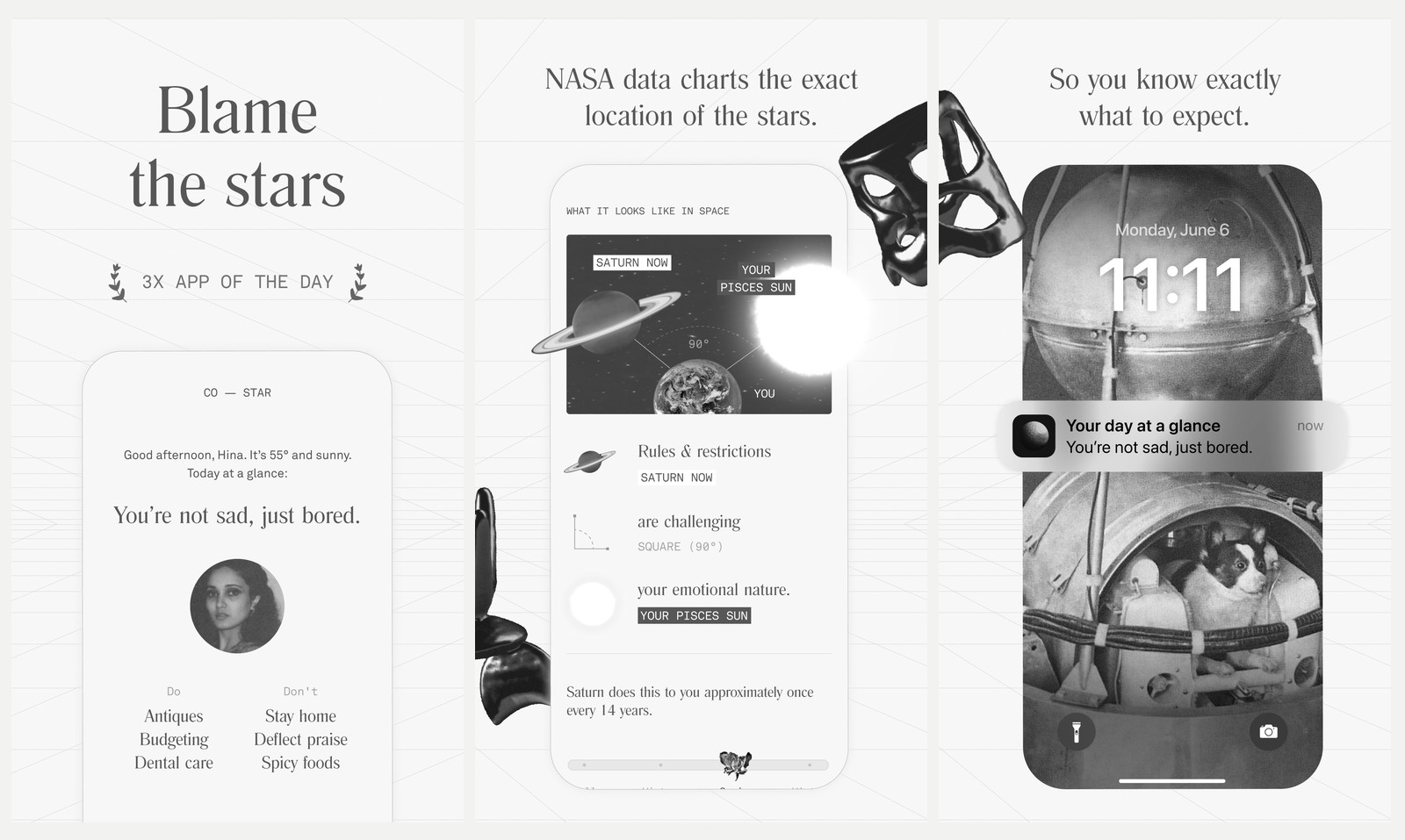
Co-Star has 206,000 ratings on the US App Store, averaging 4.8 stars. On July 24, the AI image company Midjourney announced it had bought the app. TechCrunch reported that Co-Star has about 4.3 million monthly active users, that its horoscopes, compatibility readings and advice are written by both AI and humans, and that its team of about two dozen joined Midjourney. Engadget reported that founder Banu Guler became Midjourney's chief design officer.
On the day of the announcement, several one-star reviews said the app had sold out to AI. But the complaints started well before July. We pulled the 400 most recent written reviews available through Apple's US review feed, dated Dec. 7, 2025 to Oct. 2, 2026. Seventy-seven of them mention AI, ChatGPT, generative tools or em dashes, and the busiest month was January 2026, with 12 of 61. These 400 reviews average 1.89 stars, far below the app's overall 4.8, because people who bother to write tend to be unhappy. The numbers show what people complain about and when, not how many users feel that way.
Reviewers are specific about how they spot it. Two, on Jan. 16 and Feb. 6, pointed to the same construction: it's not this, it's that, joined by a dash. The second said they noticed it in many blurbs within a week of reinstalling. On June 22, someone said three different sections that day all used it. On Jan. 23, a user of several years said the daily takes had been repeating all year. On Jan. 22, a returning user from 2020 posted that day's line, which told them they were the most elaborate and sweet dessert to taste. Whipped cream was on the do list. A July 23 review, a day before the deal was announced, was titled "every horoscope reads like chatgpt."
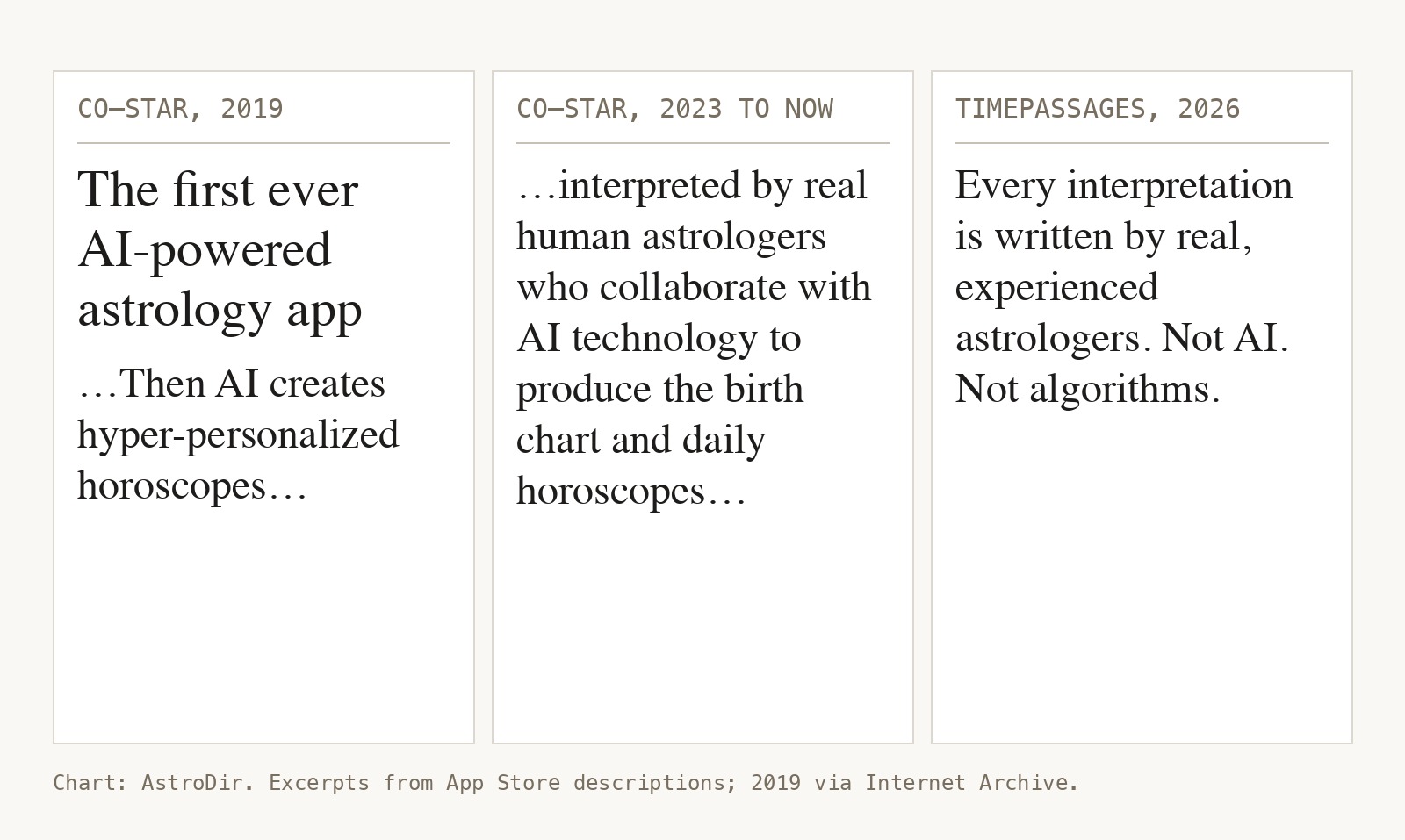
Co-Star has never claimed to be AI-free. In 2017, its founders told Vice that the app assigns astrological meanings to planetary relationships calculated from NASA data, and a program generates the text from those meanings. Its App Store description in June 2019 opened by calling it the first ever AI-powered astrology app and quoted the headline of that Vice story, about an AI that can write your horoscope. By November 2023 the wording had changed: NASA data is interpreted by real human astrologers who collaborate with AI technology to produce the charts and daily horoscopes. That sentence is still there today.
The same 2019 archive also keeps that year's reviews, and some sound familiar. On April 29, 2019, a two-star reviewer described the daily updates as an algorithm stringing together sentences by English majors with a taste for drama, reading like a county-fair fortune teller promising gloom. On March 12, 2019, a four-star reviewer noticed that much of the phrasing across friends' charts was identical. Back then people said "algorithm," not ChatGPT, but they were already complaining about repetition, stock phrasing and a dark tone. That tone still comes up: reviews on Sept. 19, 20, 25 and 29 called the app too negative, one saying it urges a breakup with their partner every other day.
As for the em dash, Co-Star's own copy has always used plenty of them. The 2019 description has two, and the release notes from the past year repeatedly say there is even more to fix, especially bugs, with a dash in between.
Co-Star hasn't explained whether its writing process changed. From version 5.18 in December 2025 to 5.43 on Aug. 1, the release notes rotate through a few fixed lines about planets moving and bugs fixed. Money comes up even more often than AI. By a rough keyword count, more than 100 of the 400 reviews mention paying, subscriptions, charges or refunds. Some describe less free content: on Dec. 11, 2025, someone said the deeper reading was no longer free; on Jan. 28, someone said the personalized daily summary had been cut; on Sept. 7, someone found this year's birthday reading behind a paywall. The listing shows Pro-Star at $8.99 a month, questions to the app at $2.99 for five or $6.99 for 25, and a Your Year Ahead report at $11.99. The newest review, on Oct. 2, says buying one question pack triggered five charges, with refunds handled through Apple.
At least one competitor now stresses the opposite on its store page. TimePassages, a long-running astrology app, now says in its listing that every interpretation is written by experienced human astrologers, with no AI and no algorithms.
So what do reviewers mean when they say Co-Star reads like AI? The app itself has said on its store page for seven years that AI helps write its horoscopes. What this year's reviewers point to is repeated dos and don'ts, one recurring sentence pattern and a gloomy tone. Repetition and gloom were already in the 2019 reviews; this year, the complaints come with the names ChatGPT and Midjourney attached. Who writes the horoscopes today, and with which model, isn't in the public record. If you're thinking about paying, read the free daily horoscope for a month first and count how often the dos, don'ts and daily line repeat. When reviewers say the app reads like AI, that is the most concrete evidence they offer.
Related apps
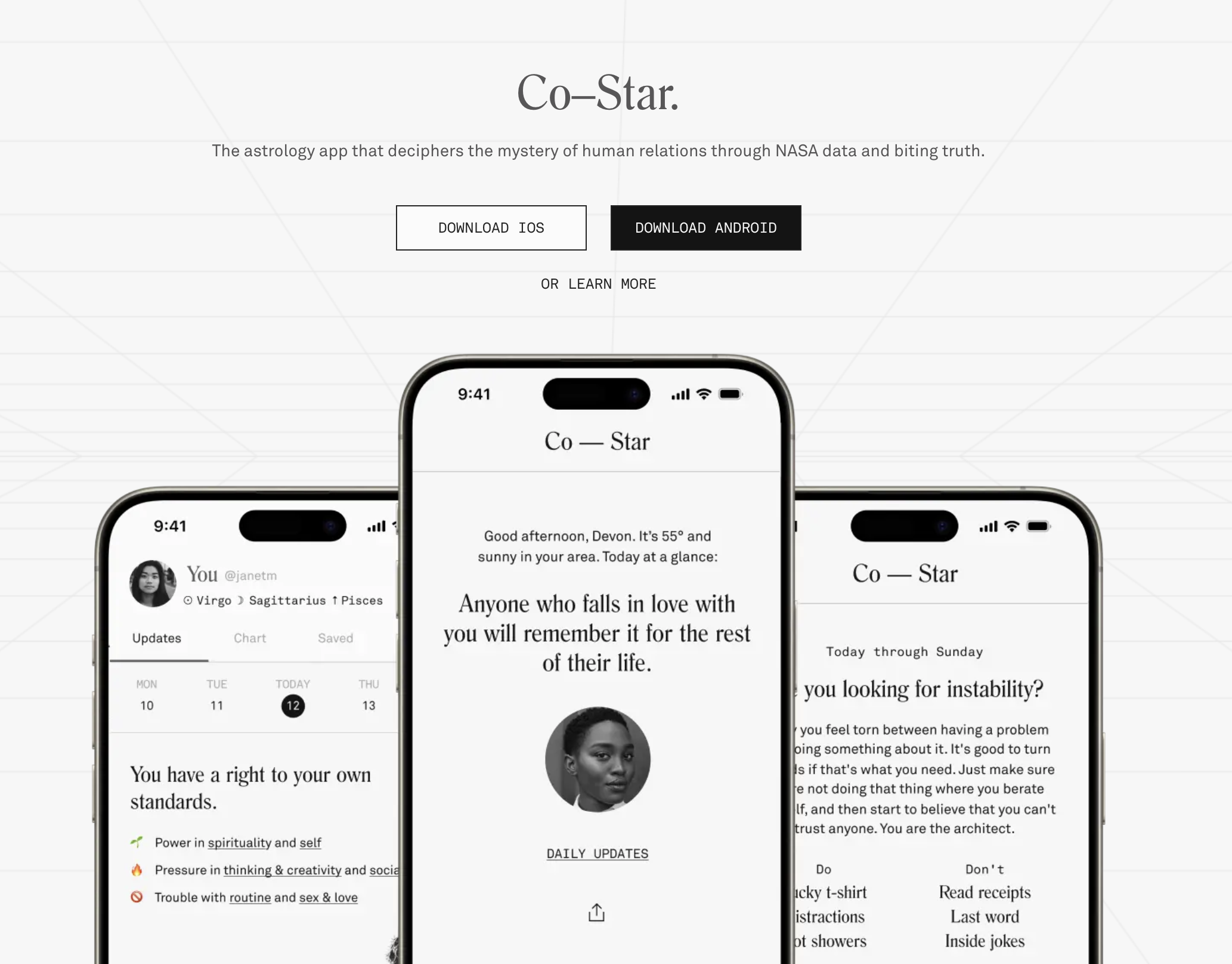 Co-Star AstrologyFor people who want a personalized daily horoscope and like comparing charts with friends.
 TimePassagesTimePassages. YOUR DAILY HOROSCOPE, PERSONALLY YOURS Unlike generic sun-sign horoscopes, your daily horoscope is calculated from your unique birth chart. Your birth chart and daily horoscope are always free.
Recommended
 FateKitSponsoredBest for astrology and Chinese-metaphysics readers who want to compare several chart systems for the same moment, inspect the sky data behind them, and prepare structured context for an external AI without uploading a profile by default.
 Cantian AIFor people who want AI Bazi readings and also want to cast a hexagram, check feng shui, or choose a name in the same app.
Sources
- App StoreCo-Star App Store reviews
- TechCrunch (via Yahoo)TechCrunch via Yahoo
- EngadgetEngadget
- ViceVice, Oct. 31, 2017
- Internet ArchiveCo-Star App Store page, June 2019 archive
- App StoreTimePassages App Store page
Similar stories
You Can Now Ask Siri to Ask Your AI Astrologer
A month into iOS 27, Hypergate AI and yap let the new Siri pass questions to their AI astrologers. Both are tiny apps; Co-Star, Nebula and CHANI haven't mentioned Siri, and the answers depend on each app's own AI.
AI AstrologyVoice AI
Siri Can Tell You the Planetary Hour. It Can't Read Your Horoscope Yet
Two weeks into iOS 27, Siri handles astrology only in a narrow way: a few small apps let it answer what planet rules the hour or where the Moon is tonight. Ask about your day and it has nothing, because Co-Star, CHANI, Nebula and the other big reading apps have not plugged in.
AI AstrologyApp store updates
This AI Astrology App Thought It Was Still 2023. Now It's Back
SINE shipped version 2.0 on Oct. 15, its first update since December 2024, with a new backend and tarot readings matched to the cards drawn. While it sat untouched, reviewers said its AI read their transits for October 2023, then the app stopped loading altogether.
AI AstrologyAI Tarot