
An AI Astrology App Rewrote Its Terms. Think Before You Add Your Friends
Lora launched on September 14 as a free app with no in-app purchases. On September 30 it rewrote its terms: some features now need a subscription, its chats are generated by unnamed third-party AI models, and it can sync your contacts. Its main feature asks you to add partners, family and coworkers.
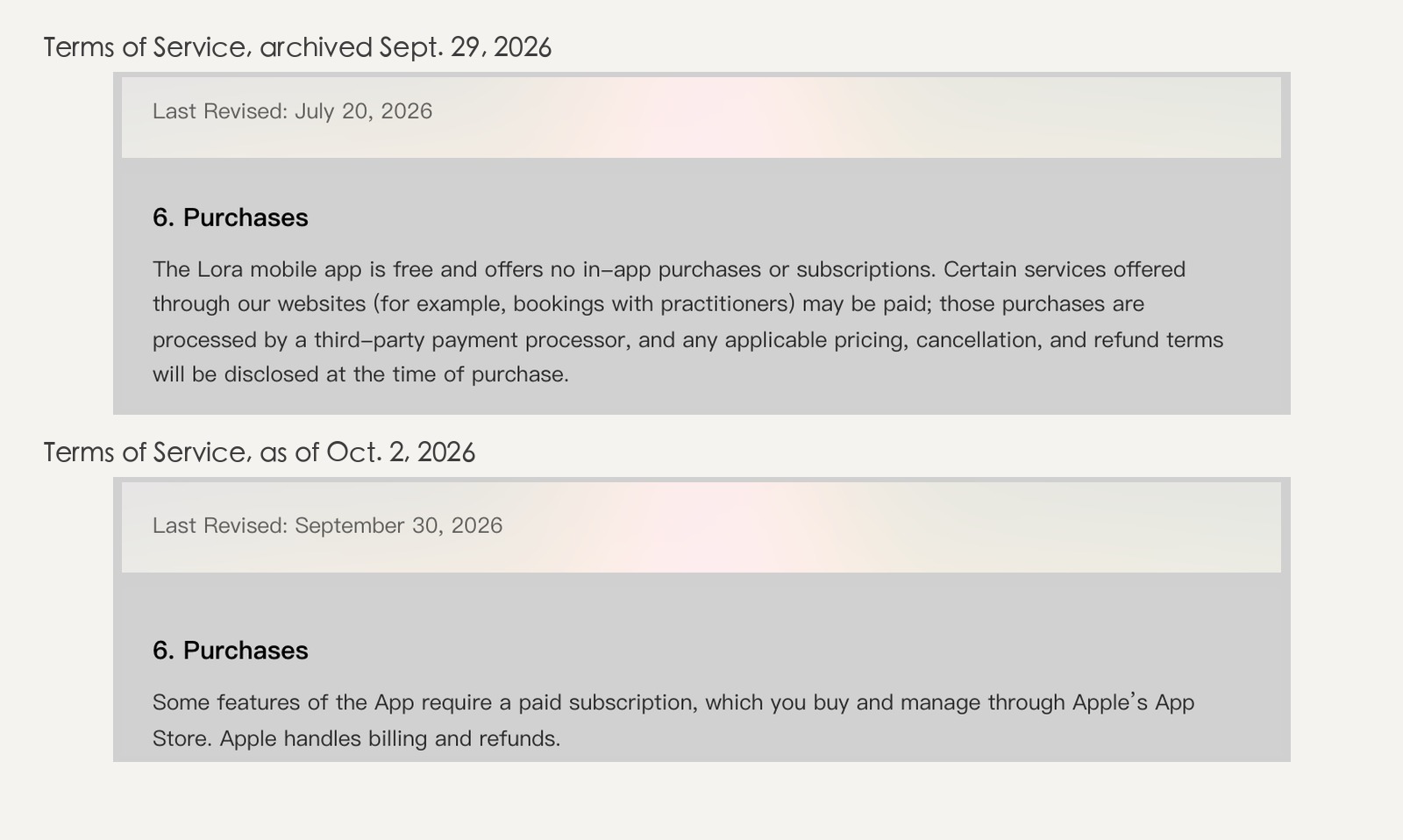
On September 29, the terms of service for Lora, an AI astrology app, still said the mobile app was free and "offers no in-app purchases or subscriptions." A day later that line was gone. The new version says some features require a paid subscription, bought and managed through Apple's App Store, and the App Store listing now reads "Free · In-App Purchases," though it does not yet show what is for sale or at what price. Lora launched on September 14 and reached version 1.1.6 on September 26; by October 2 it had 97 ratings averaging 4.9 stars. Its founder, Michelle Parsons, worked at Hinge, Netflix and Spotify and co-founded the queer social app Lex. The pre-seed money came from AlleyCorp in New York.
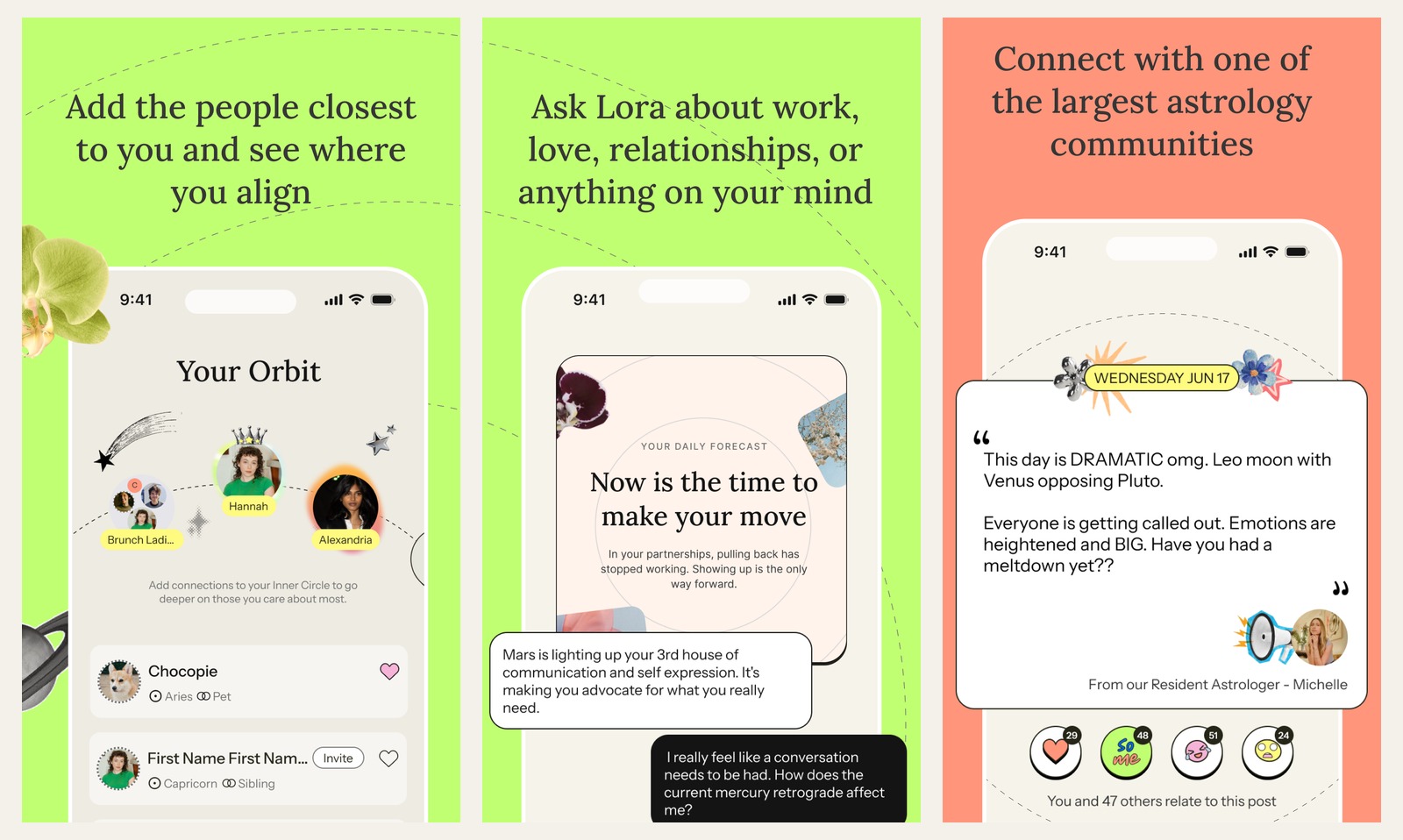
An astrology app starting to charge is not news. What Lora asks you to hand over is more interesting. Its central feature is Orbit, a map of the people in your life: partners, friends, family, colleagues. You can sync your contacts or add people by hand, then see how your charts line up, get a daily snapshot of how things stand between you, and ask Lora about any of those relationships. The support page says Lora remembers the context of each relationship in your Orbit, so the answers get more specific the more you talk. A weekly recap, delivered Sunday night, tells you who came up most in your conversations. Version 1.1.6 added a home-screen widget showing your friends' daily "Auras." In the App Store screenshots, one person in the sample Orbit is tagged "Sibling" with an "Invite" button beside the name, which means the people you add do not need to be on Lora themselves.
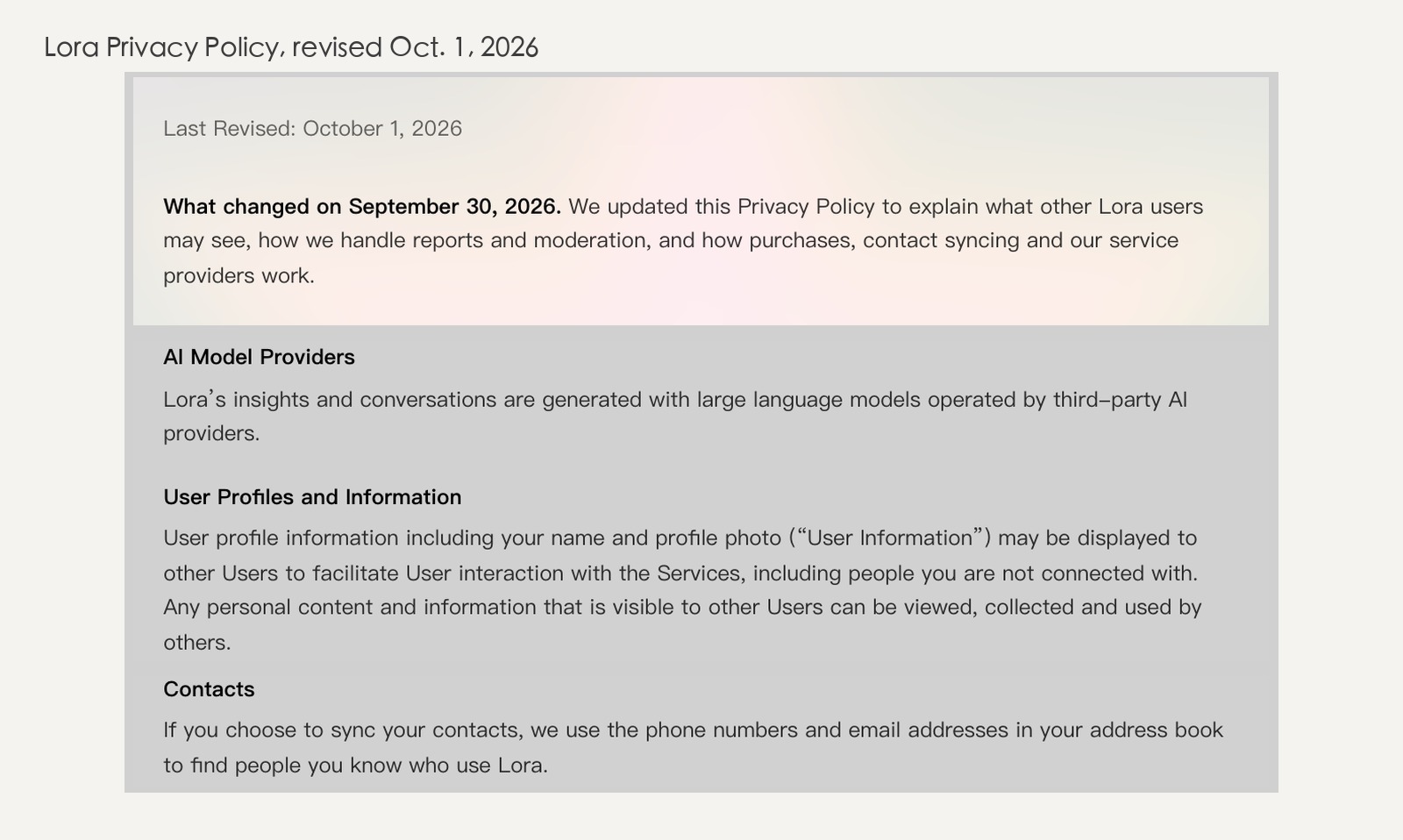
Who processes all that? On the same day, Lora's privacy policy gained a section headed "AI Model Providers," stating that Lora's insights and conversations are generated with large language models run by third-party AI companies. The July 20 version had no such section. The new one does not name the provider, and it does not say whether those providers keep what they receive. When Business Insider covered Lora's launch party on AlleyCorp's SoHo rooftop on September 26, it suggested the app's biggest competitors might be the big models themselves, since anyone can paste a birth chart into ChatGPT or Claude. Lora's answers, it turns out, also come from someone's large language model. What it adds is the relationship map and the memory. Meanwhile its support page still says, as of October 2, that your birth details and personal data are never sold or given to anyone.
The rewrite also moves Lora closer to being a social network. A note at the top of the privacy policy says the September 30 changes explain what other users can see, how reports and moderation work, and how purchases, contact syncing and service providers operate. Your name and profile photo may now be shown to other users, including people you have no connection with. Syncing contacts means Lora uses the phone numbers and email addresses in your address book to find people you know on the app. The terms add community standards, reporting and blocking, plus a user-content license: Lora may use, modify and sublicense your messages and photos worldwide, royalty-free, to run and improve the service and build new ones, and the license survives your departure for anything you shared with other users. The App Store screenshots already show a community feed, with a sample post signed by a "Resident Astrologer" collecting more than 150 emoji reactions.
What about the people in your Orbit? A clause on content about other people, already present in July, says that when you add someone's information or sync your contacts, you are representing that you have the right to share it, and you are responsible for its legality and accuracy. Lora does not ask your coworker for permission; that is on you. The account-deletion promise has shifted too. On September 29 the support page said deleting your account wiped all personal data from all systems immediately. Now it points to the privacy policy for what is deleted and what is kept. The policy says deletion removes your profile, birth details, chart, conversations and Orbit, but the company may keep an archived copy for legal reasons or legitimate business purposes, and its California section says personal information is retained for as long as you actively use the service plus six years.
Lora is not only AI. A separate site, book.getlora.com, lists 55 human astrologers, tarot readers and other practitioners as of October 2, with sessions priced from $10 to $500, no refunds for cancellations within 24 hours, and free applications for practitioners who want to join. Free AI chat to keep people around, a subscription and humans paid by the session to bring in money: that is how Lora is set up for now. We did not install the app, so we cannot say which features the subscription will lock or how good the readings are.
So should you use it? For your own chart and your own questions, it is a reasonable thing to try. You can delete your own data, and the policy spells out what goes and what stays. Be more careful with Orbit. A birthday, a birthplace and a compatibility score are plenty. Leave out your partner's diagnosis, your coworker's feud and your sister's divorce. Those details go to an unnamed model provider to generate an answer, and the people involved may not know they were added at all. The least worried member of any Orbit is probably Chocopie, the dog in the screenshots, listed as an Aries with the relationship type "Pet."
Recommended
 FateKitSponsoredBest for astrology and Chinese-metaphysics readers who want to compare several chart systems for the same moment, inspect the sky data behind them, and prepare structured context for an external AI without uploading a profile by default.
 Cantian AIFor people who want AI Bazi readings and also want to cast a hexagram, check feng shui, or choose a name in the same app.
Sources
- LoraLora Terms of Service
- App StoreLora on the App Store
- Global Dating InsightsGlobal Dating Insights
- LoraLora support
- LoraLora Privacy Policy
- Business InsiderBusiness Insider
- LoraLora practitioners
Similar stories
This AI Astrology App Thought It Was Still 2023. Now It's Back
SINE shipped version 2.0 on Oct. 15, its first update since December 2024, with a new backend and tarot readings matched to the cards drawn. While it sat untouched, reviewers said its AI read their transits for October 2023, then the app stopped loading altogether.
AI AstrologyAI Tarot
AI Astrologers Now Give You the First Answer Free. Check What the Second One Costs
In early October, several AI astrology apps in the US and India made the first question free. What happens next varies: some price each answer up front, while AstroSage bills its named AI astrologers by the minute, and that is where the complaints pile up.
AI AstrologyAstrology Marketplaces
Three Newsrooms Asked AI for October's Luckiest Signs. They Got Three Answers
AOL runs a daily horoscope credited to Google Gemini, and Argentine and Mexican outlets publish monthly AI luck rankings. Checked against an ephemeris, the AI gets the sky right. Who gets lucky depends on which outlet asked which bot, and one paper now credits Gemini to OpenAI.
AI AstrologyContent formats