
This Feng Shui App Scans Your Home and Pins the Flying Stars to the Floor
Hong Kong's Karma Space has you walk your flat with an iPhone, builds a 3D model with LiDAR, takes the door's bearing and lays a Flying Star chart across the floor. It labels AI advisers and human masters separately and says its readings won't use scare tactics. It's still tiny: 18 homes scanned so far.
The instructions on the scan screen are short: walk along the walls, catch every doorway, the bathroom and the kitchen, then move slowly past each piece of furniture until it turns green. The app is Karma Space, known in Chinese as 玄居, and it reached Hong Kong's App Store on Sept. 28, 2026. On an iPhone Pro with a LiDAR sensor, it turns a flat into a 3D model with walls, doors, windows and furniture, walks you through measuring which way the front door faces with a built-in compass, and then lays a Flying Star chart, the nine-square grid of classical Chinese feng shui, directly onto that plan. Phones without LiDAR can upload a floor plan or draw one by hand.
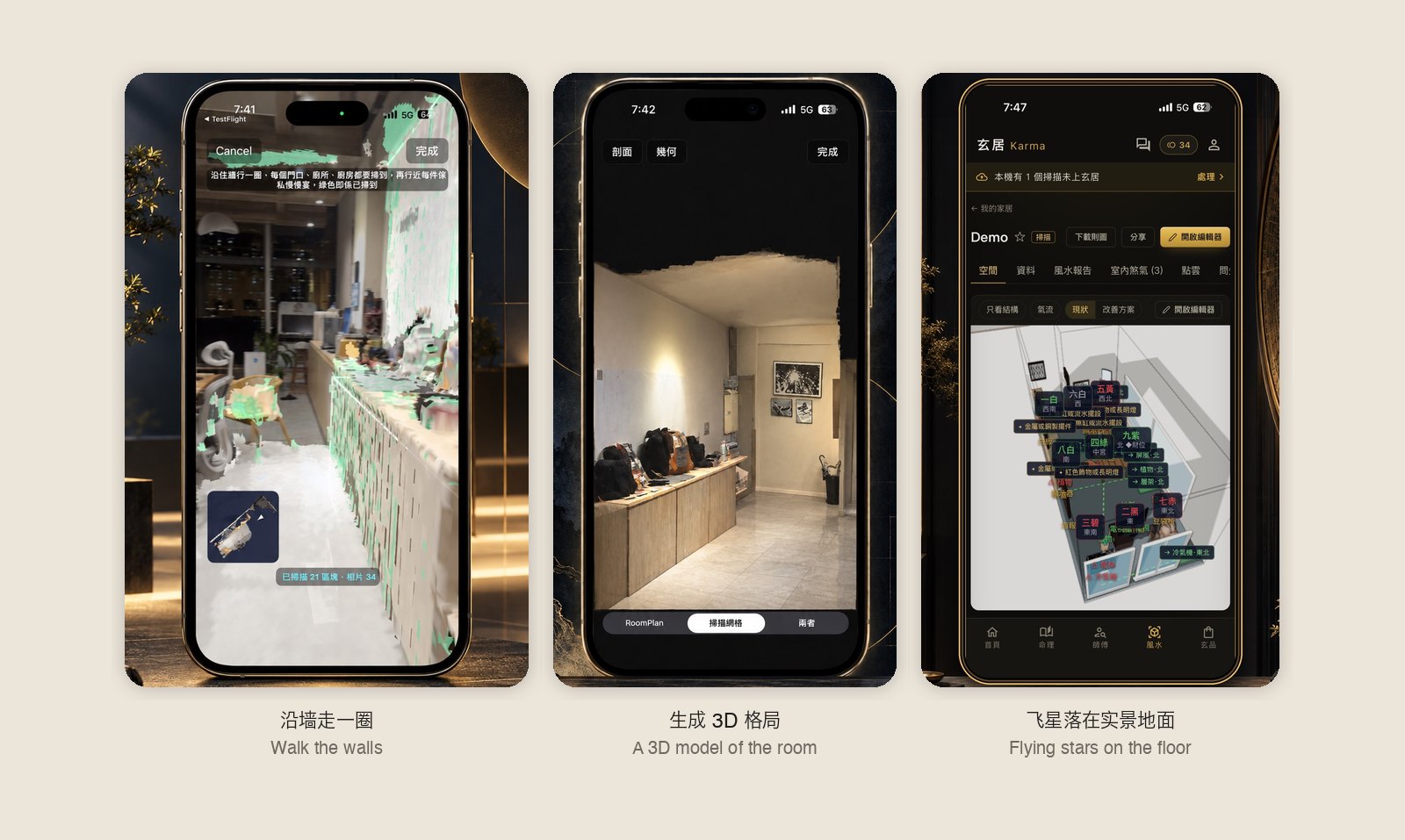
The demo flat in the store screenshots comes out divided into nine squares. The Nine Purple star sits in the north, marked as the wealth position, with tips attached: a screen to the north, a plant to the north, the air conditioner in the northeast. The dining chairs and the air conditioner each carry a red warning, and tabs above the model read "indoor sha (3)," "feng shui report" and "improvement plan." A consultation used to start with a master visiting in person to take compass bearings, measure and sketch the layout. Karma Space hands that step to the phone; the reading that follows is still Flying Star feng shui.
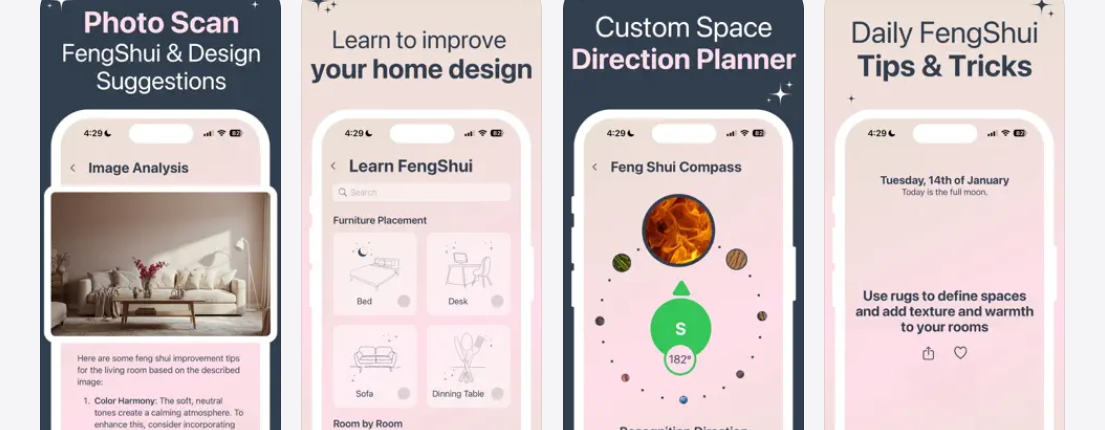
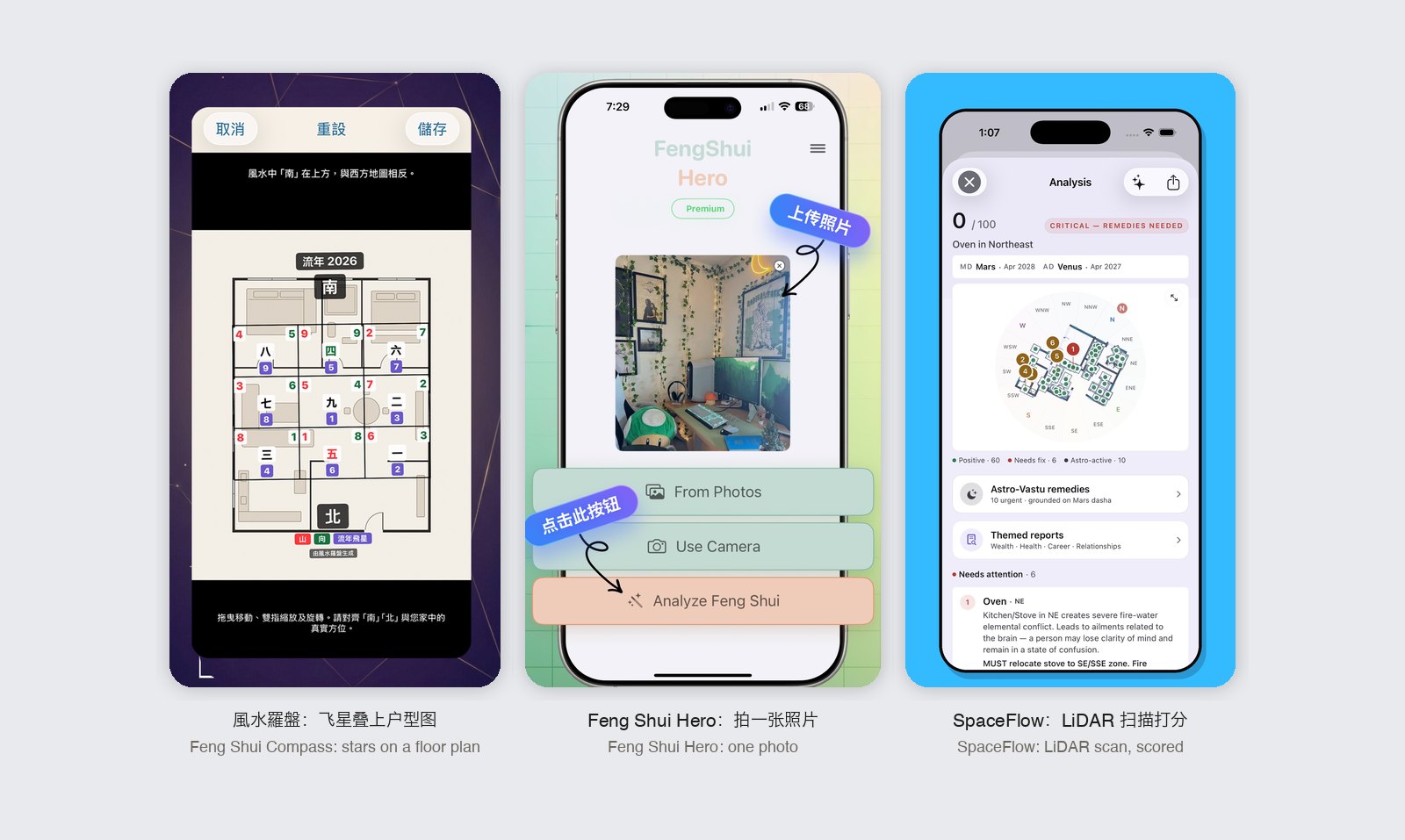
Phone apps have handled floor plans for a while, mostly in two ways. Some overlay a chart on a plan you already have: Hong Kong's Feng Shui Compass AI Master takes the door's bearing in AR, then lays the nine squares over a floor plan from your photo library and lets you ask an AI about the result. Others want only a photo. Feng Shui Hero takes a picture of a room and returns a score in seconds. Karma Space isn't the first to bring LiDAR into it either. India's SpaceFlow, on the App Store since 2025, scans rooms into a floor plan and grades them out of 100 against a 16-direction Vastu grid. What Karma Space adds is a chart aligned to true north and fixed to a model with real dimensions, staying on the floor as you rotate the view.
A "research progress" page on the company's site spells out how much it wants the phone to do. Scanning runs on Apple's RoomPlan and was finished in August and September: walls, doors, windows and furniture, auto-aligned to true north. A vision model then identifies objects frame by frame, from monitors and arcade machines to fish tanks and framed pictures, down to plant species, because the rules later treat some species as lucky and others not. The scan's point cloud is used to measure daylight, openness, how energy gathers and how people move, drawn as heat maps, before rules for doors facing doors, straight-through drafts and beds facing doors flag problems. Offices get their own rules, including a boss's chair backed by a solid wall. Multi-room scanning is in progress. Further out, the plan is to pull nearby roads, water and hills from the address, the outer landforms feng shui also reads.
The way it explains feng shui has an engineering flavor too. The site translates a door lined up with a back door or window as an airflow short circuit, an open view out front as daylight and outlook, and a gloomy, "yin-heavy" room as low light, high humidity and poor ventilation, problems that, the homepage says, take three kinds of sensors to measure today. An Aug. 25 article on the site says the AI's readings quote classical texts by passage, and the homepage counts 3,154 checked entries. Those are the company's claims; the checking itself isn't visible from outside.
It is also strict about who is answering. Anyone called xiansheng on the site is an AI, each named after a historical figure: Xu Ziping for Four Pillars readings, Guiguzi for relationships, Fan Li for career and money, Bao Gu for health routines, Yang Yunsong for home feng shui, Wang Yangming for modern life, with an AI called Jingli giving the final verdict. The directory notes they are AI advisers set up on each figure's methods, not the people themselves. Human masters are called shifu, and the FAQ says the two are never mixed and the AI won't pose as a master. That human side has barely started. On Oct. 13, the directory listed a single master, 22 years in practice, based in Sham Shui Po, tagged as new with no reviews; the FAQ says booking is opening in stages, with clients scanning their own homes and masters reviewing the model remotely.
The FAQ's most pointed answer is about whether readings are made to sound dire so you'll pay. Karma Space says every AI adviser's instructions ban frightening language and ban ending with a nudge to sign in or buy; a low-scoring day reads as "keep steady," not "very unlucky." Its human masters, it adds, won't sell ritual objects or run the "fix it or something bad will happen" routine. Public material from other apps shows the kind of thing it is promising not to do. In SpaceFlow's store screenshot, the demo home scores zero because the oven is in the northeast, which the text says leads to ailments related to the brain, ending with an instruction that the stove must be moved to the southeast. In Taiwan, SeerQ, which also pairs AI readings with human advisers and ranked No. 49 on the free Lifestyle chart on Oct. 13, drew six one-star reviews between Sept. 16 and Oct. 10 saying advisers pushed paid rituals or remedies during consultations. The one five-star review in that stretch to mention rituals warned, with a laughing emoji, that the app will have you buy one, and an expensive one.
A rule in an FAQ will only be tested once human masters take bookings and reviews pile up. For now Karma Space is tiny: 12 ratings in Hong Kong, and a homepage counter showing 150 accounts, 100 readings and 18 real homes scanned. The new part is the first half of the process, where the phone does the measuring and the nine squares sit inside a room with real dimensions. Whether the square marked "wealth" in the north really brings money is something no sensor can measure. That remains Flying Star doctrine.
Related apps
 風水羅盤 - AR羅庚飛星排盤、AI風水師Useful for users who want AR compass measurement, flying-star charting, and AI feng shui answers.
 Feng Shui HeroUseful for users who want a photo-based Feng Shui scan with scores and room-specific suggestions.
 SpaceFlowMap AIUseful for users who want Vastu and Astro-Vastu suggestions from room scans and birth-chart data.
 SeerQ - See BeyondSeerQ - See Beyond. It relies on AI and digital technology to build a SaaS platform to connect users who are confused about life choices and need private professional help with high-quality mentor institutions around the world. a global digital platform for life coaches, helps you plan your life and make life simpler.
Recommended
 FateKitSponsoredBest for astrology and Chinese-metaphysics readers who want to compare several chart systems for the same moment, inspect the sky data behind them, and prepare structured context for an external AI without uploading a profile by default.
 Cantian AIFor people who want AI Bazi readings and also want to cast a hexagram, check feng shui, or choose a name in the same app.
Sources
- Apple App StoreKarma Space on the App Store
- Apple App StoreFeng Shui Compass AI Master on the App Store
- Apple App StoreFeng Shui Hero on the App Store
- Apple App StoreSpaceFlow on the App Store
- Karma SpaceKarma Space research page
- Karma SpaceKarma Space, "When feng shui meets AI"
- Karma SpaceKarma Space homepage
- Karma SpaceKarma Space masters directory
- Karma SpaceKarma Space FAQ
- Apple App StoreSeerQ reviews, Taiwan App Store
Similar stories
AI is starting to read floor plans
Room photos, floor plans, and LiDAR scans are moving into the core flow of Feng Shui apps. The market is early, but the new shape is visible: AI reads the space before it gives advice.
AI Feng ShuiFloor Plan
An AI Reads Your Turkish Coffee Cup in Seconds. The Human Readers Make You Wait
Turkey's coffee cup reading apps have long sent your photos to human readers, and reviews complain about hours of waiting and stock phrases. Telveden lets AI read the grounds in seconds, publishes its 85-shape atlas and sources, and admits a different model would see different shapes.
AI DivinationAI metaphysics products
Auvylo turns birth charts into people you can talk to
Auvylo turns Four Pillars, natal charts, and relationship context into AI personas, making relationship patterns feel less like a static report and more like a conversation.
AI metaphysics productsContent formats