
Korea's Newest Saju Apps Want You to Bring a Friend
Types now trades unlimited saju questions for friend invites, and at least five new Korean fortune apps since September are built around the people you know: a benefactor field guide, group-chat compatibility rankings, a couples drawing game and an AI that reads your crush's texts. Their ratings are still in single digits, but they're all heading the same way.
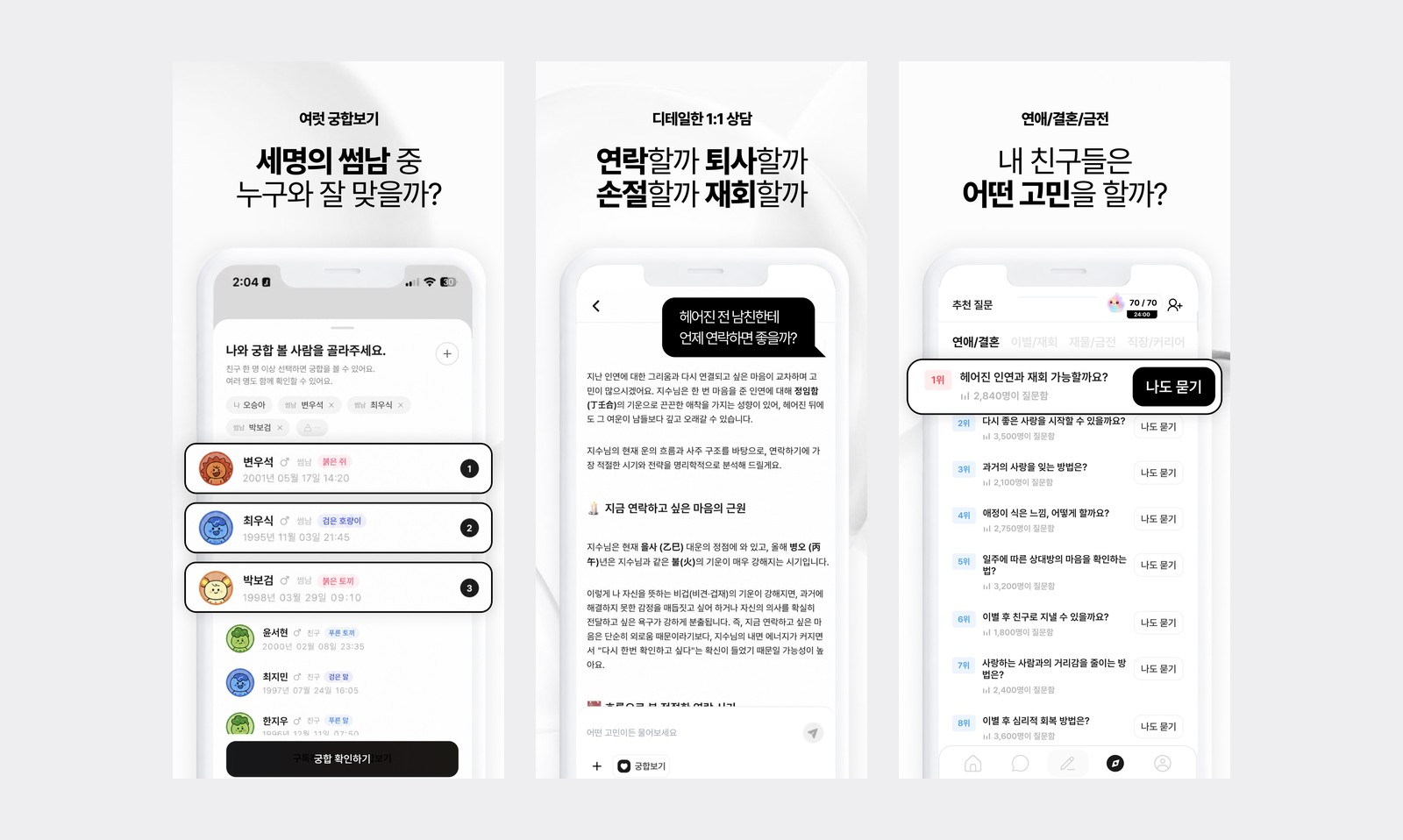
Types, a Korean personality-quiz app, shipped an update on Oct. 18 whose release notes open with an offer: saju questions are free and unlimited, and inviting a friend earns you an unlimited pass. Its AI Q&A had been rebuilt days earlier so you can choose whether a question is about you, a friend, or the two of you. Around the same time, a wave of new saju and compatibility apps arrived on Korea's App Store. Between Sept. 10 and Oct. 15, AstroDir counted at least five, and every one of them is built around the people in your life.
Saju is the Korean name for BaZi, the "four pillars" reading of your birth date and hour, and most fortune apps have treated it as a solo activity: one person, one chart, pay per question or per month. This new batch sells the relationship instead. Results become links, cards and leaderboards that you send to a friend, who can often join without installing anything. The friend is both the subject of the reading and the app's next user. All five are tiny for now, with one to three ratings each, so this is a product direction rather than a hit. But several teams landed on it at once.
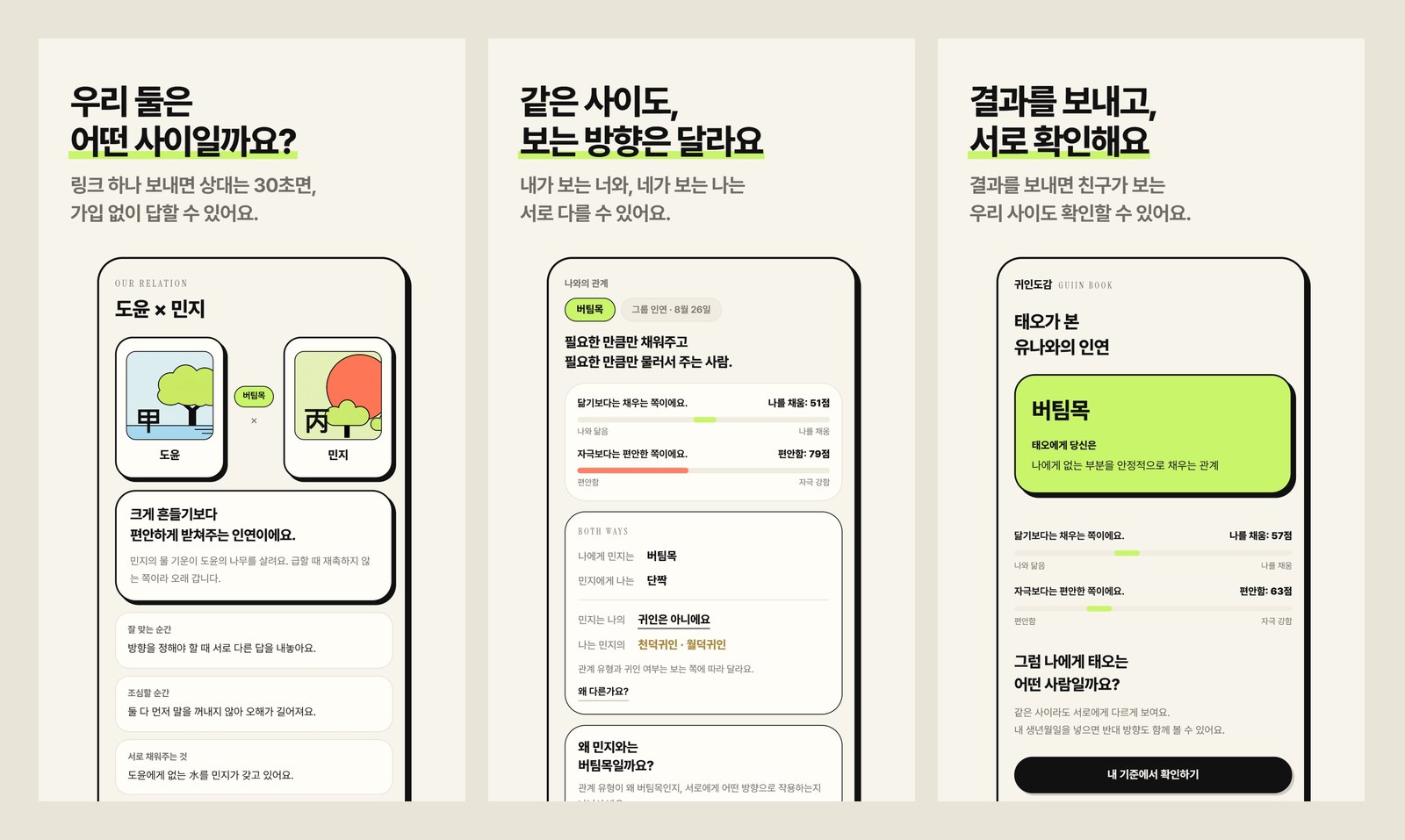
The most developed is Guiin Dogam, roughly "benefactor field guide," which launched Sept. 29. You collect friends, partners, relatives and coworkers like entries in a field guide, and it uses both birth charts to label each relationship and flag who your benefactors are. The hook is that relationships run in one direction at a time. In the App Store screenshots, the user sees Minji as a pillar of support, while Minji sees the user as just a best buddy. Minji isn't the user's benefactor, but the user is Minji's. A friend can answer through a link in about 30 seconds without signing up, then enter their own birth date to see the relationship from their side. Groups get rankings and a daily question.
Yeonseupjang Dwitjang, or "the back of the notebook," went live Oct. 7 and is pure nostalgia. Korean students used to write two names in alternating syllables on the back page of a notebook, count the strokes in each, and add neighboring numbers, keeping only the last digit, row after row, until two digits remained: the couple's compatibility score. The app draws that pyramid exactly, then runs it again with the names swapped to show who likes whom more. It works from names, not birth charts, and makes no claim to AI. It also has group-chat compatibility rankings and an eight-question "how well do you know me" test, and friends can join from a link. The listing says the names you type aren't stored on its servers.
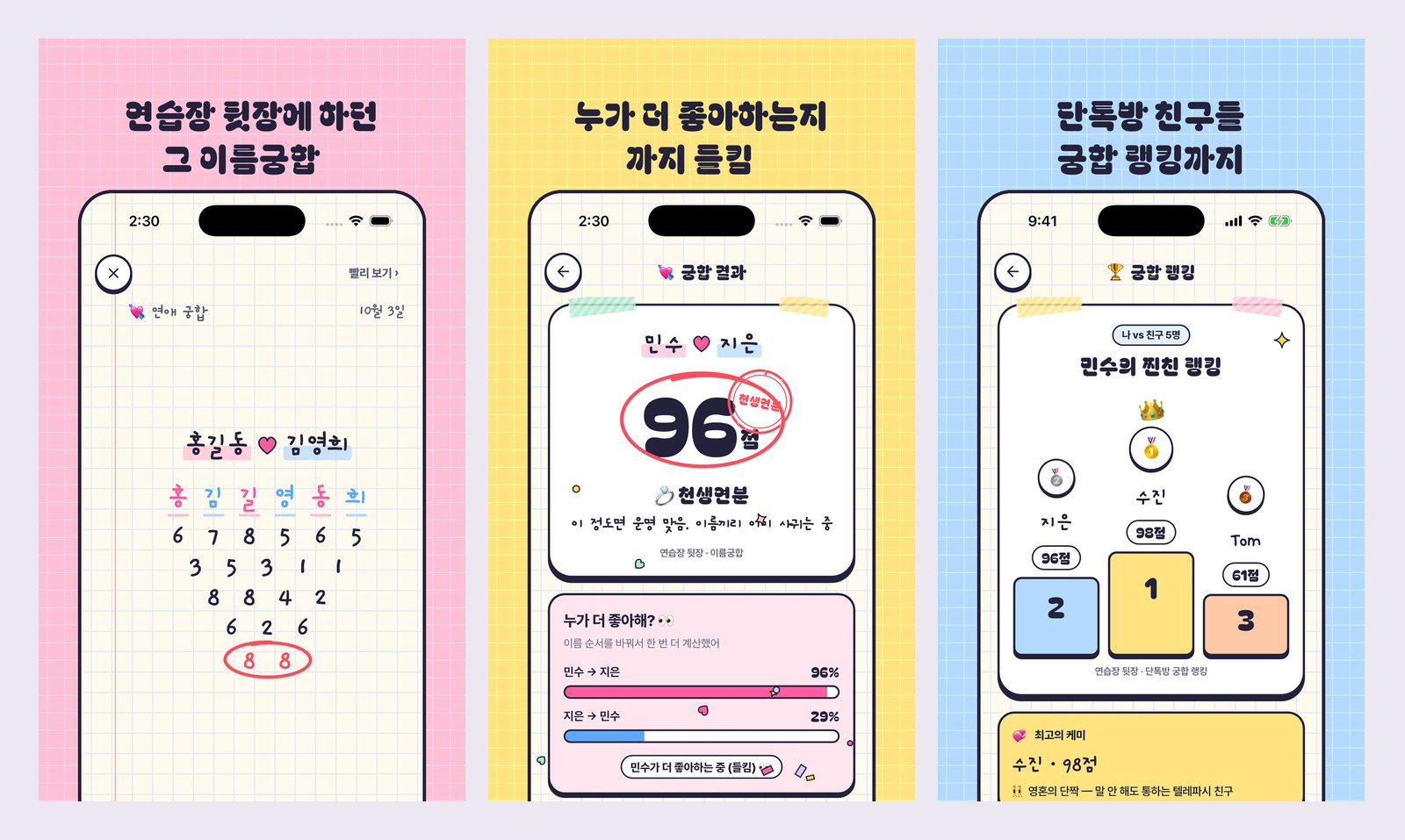
Two others make the invitation part of the rules. GORI, which launched Sept. 10, mixes saju with Western astrology and only unlocks a relationship report once you and a friend link up through a friend code or invite link. When a new user signs up through that link, both people get in-app rewards. Ondul, which launched Oct. 15, is for couples. Each partner draws half of a picture every day, and the halves become a card to save or share, alongside "my day," "your day" and the couple's compatibility. The drawing game doesn't work until your partner connects.
ZZEND, live since Sept. 30, leans hardest on AI and focuses on just one person, the one you're texting. Upload a chat screenshot and it explains what their message really means, scores their interest out of 10 and drafts replies in four tones. Add their birth date and it reads their saju too. In the screenshots, Junho scores 7.4, and the app notes that he wants to keep talking but keeps pushing back plans to meet. Before you hit send, you can rehearse with an AI that imitates Junho's tone, and that AI can even "call" you first. The listing stresses that ZZEND never sends anything on your behalf and deletes screenshots right after reading them, keeping none of the other person's words.
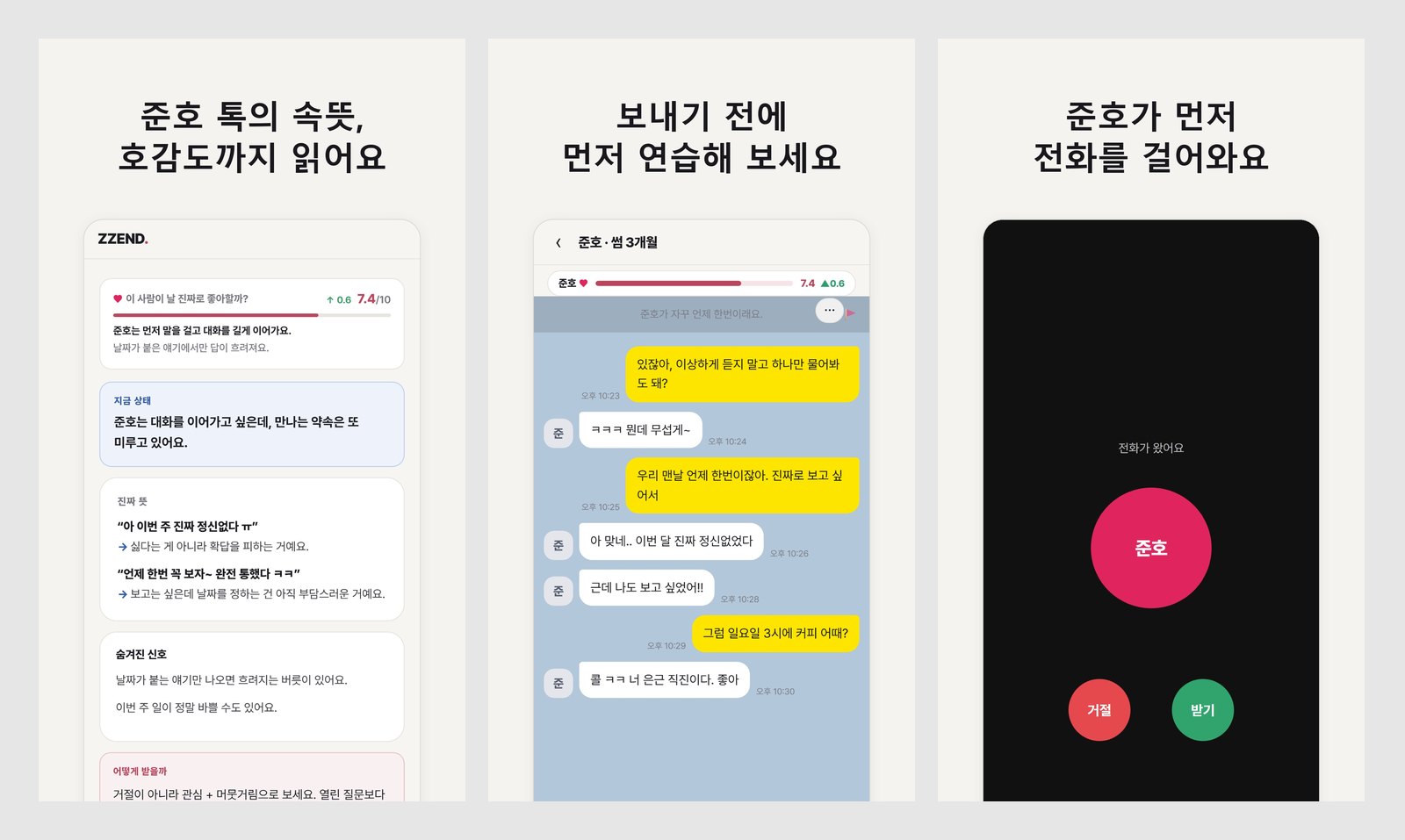
All of this means you're no longer handing over only your own birth date. Compatibility needs two people's details, and the apps handle that differently. Guiin Dogam lets friends answer for themselves through a link. Ondul says neither partner's birth date or time is shown to the other. ZZEND asks you to type in the other person's birth date yourself, without them knowing. Higher up the charts, the same instinct shows. Saju Witch, No. 22 on Korea's top-grossing Lifestyle chart on Oct. 19, lets you save profiles for family and friends and share the readings you've bought.
Whether any of these keep their users is impossible to say yet, since their ratings are still in single digits. But that notebook game was never fun to play alone. Doing the sum with your own name was never the point, and Korea's newest fortune apps seem to have remembered that.
Related apps
 타입스Useful for people who want a practical astrology app built around charts, timing, and repeat use.
 귀인도감 - 누가 내 귀인일까Korean readers comparing Saju relationships with people they know.
 고리 GORI : 사주, 운세, 점성, 관계, 궁합GORI combines Korean Saju and Western astrology to create a personal character and temperament report from birth details.
Recommended
 FateKitSponsoredBest for astrology and Chinese-metaphysics readers who want to compare several chart systems for the same moment, inspect the sky data behind them, and prepare structured context for an external AI without uploading a profile by default.
 Cantian AIFor people who want AI Bazi readings and also want to cast a hexagram, check feng shui, or choose a name in the same app.
Sources
- Apple App StoreTypes on the App Store
- Apple App StoreGuiin Dogam on the App Store
- Apple App StoreYeonseupjang Dwitjang on the App Store
- Apple App StoreGORI on the App Store
- Apple App StoreOndul on the App Store
- Apple App StoreZZEND on the App Store
- Apple App StoreSaju Witch on the App Store
- Apple App StoreApp Store Korea top-grossing Lifestyle chart
Similar stories
A Korean "Shaman" AI Is Selling BaZi Readings in Taiwan
Korean AI fortune app Tight Saju reached Taiwan in September and was No. 29 on the Lifestyle top-grossing chart by Oct. 14 with no local ratings; Korea's MYPIE was No. 26. One sells shaman characters, 20,000-character AI reports and a Taiwanese moon-block ritual; the other an AI adviser. Taiwanese reviewers praise the AI and fault the charts.
BaZiEast Asian divination
A Saju "Brain Map" Went Viral in Korea. The Money Is in 990-Won AI Readings
Hongsimdang's free saju brain map has passed 530,000 images, and its operator credits one X post with 4.57 million views. Like August's viral benefactor map, the free image is made to be shared, while the money comes from AI saju readings at 990 won each.
BaZiEast Asian divination
An AI Saju App Sells Its Memory. Its Worst Reviews Are About That, Too
Korean AI fortune app Sajuping markets itself as the friend who remembers you, and its Oct. 6 update fixed mixing up the people you mention. Reviews praise not repeating yourself, and complain about wrong pillars, stale charts and deleted chats it still recalls. Free and paid answers use different models.
BaZiEast Asian divination