
Freud, Jung or Ibn Sirin? Dream Apps Now Let You Choose
A run of new AI dream apps turns Freud, Jung, Ibn Sirin and other interpretive traditions into tabs. The tab you pick decides what kind of answer you get, and in some apps, whether you pay for it.
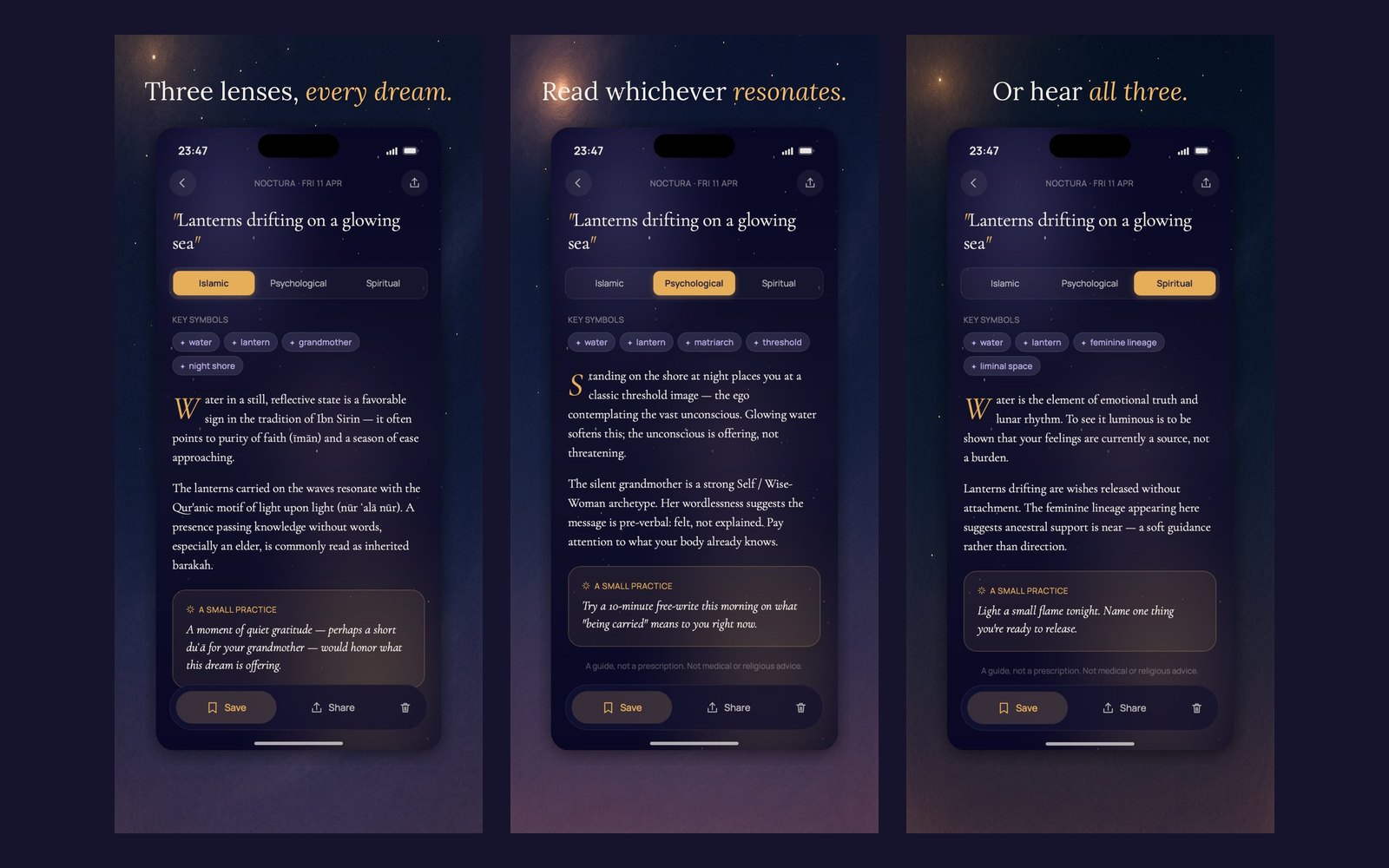
You are standing on a shore at night. The water is glowing, every wave carries a small lantern, and your grandmother is there, saying nothing. This is the sample dream Noctura uses in its App Store screenshots, and the app reads it three ways. Under the Islamic tab, still water counts as a good sign in the tradition of Ibn Sirin, pointing to purity of faith and a season of ease, and a wordless elder is read as inherited barakah, or blessing. Under Psychological, the shore becomes a threshold between the ego and the unconscious, and the grandmother an archetype of the Self and the wise woman. Under Spiritual, the luminous water means your feelings are a source rather than a burden, and the grandmother signals that ancestral support is near. Each tab ends with its own small practice: a short prayer for your grandmother, a ten-minute free-write this morning, a small flame lit tonight while you name one thing you are ready to release.
Reading one dream through several traditions has become a recurring design in dream apps launched over the past few weeks. Uyanış, a Turkish-language app released on September 10, lets you compare readings in the manner of Jung, Freud, Alfred Adler and Ibn Sirin, and its description leaves the verdict with you: you decide which reading speaks to you. Onifide, which arrived on Google Play on September 13, offers seven lenses: Freud, Jung, the tradition of Ibn Sirin, Christian tradition, Artemidorus, Vedic Hinduism, and neuroscience, which, the app notes, explains how dreaming works rather than what a symbol means. Pick several and it lays the readings side by side, then writes a synthesis of where they agree and where they part ways.
Several developers seem convinced they got there first. Dream Sage describes itself as the only dream app with six lenses and the first to show them side by side. Onifide says of its comparison feature, “No other app does this.” Mythos, a French-language app released on August 20, notes that most dream apps offer one interpretation while it offers three at once. Put the claims next to each other and the feature no longer looks rare.
Mythos spells out the difference most plainly. Its selection screen asks which tradition you want interpreting the dream, and pairs each option with a question of its own. Artemidorus, second century, Greco-Roman, treats dreams as omens and asks what they foretell about waking life. Ibn Sirin, eighth century, Islamic scholarship, treats them as messages and asks what the soul or the divine is saying. Freud, twentieth century, psychoanalysis, treats them as the unconscious and asks which desires are in disguise. The sample reading under Artemidorus, headed The Watcher at Dawn’s Threshold, duly promises an imminent spiritual awakening. Before the app interprets anything, you have already decided whether you are asking about the future, a message, or yourself.
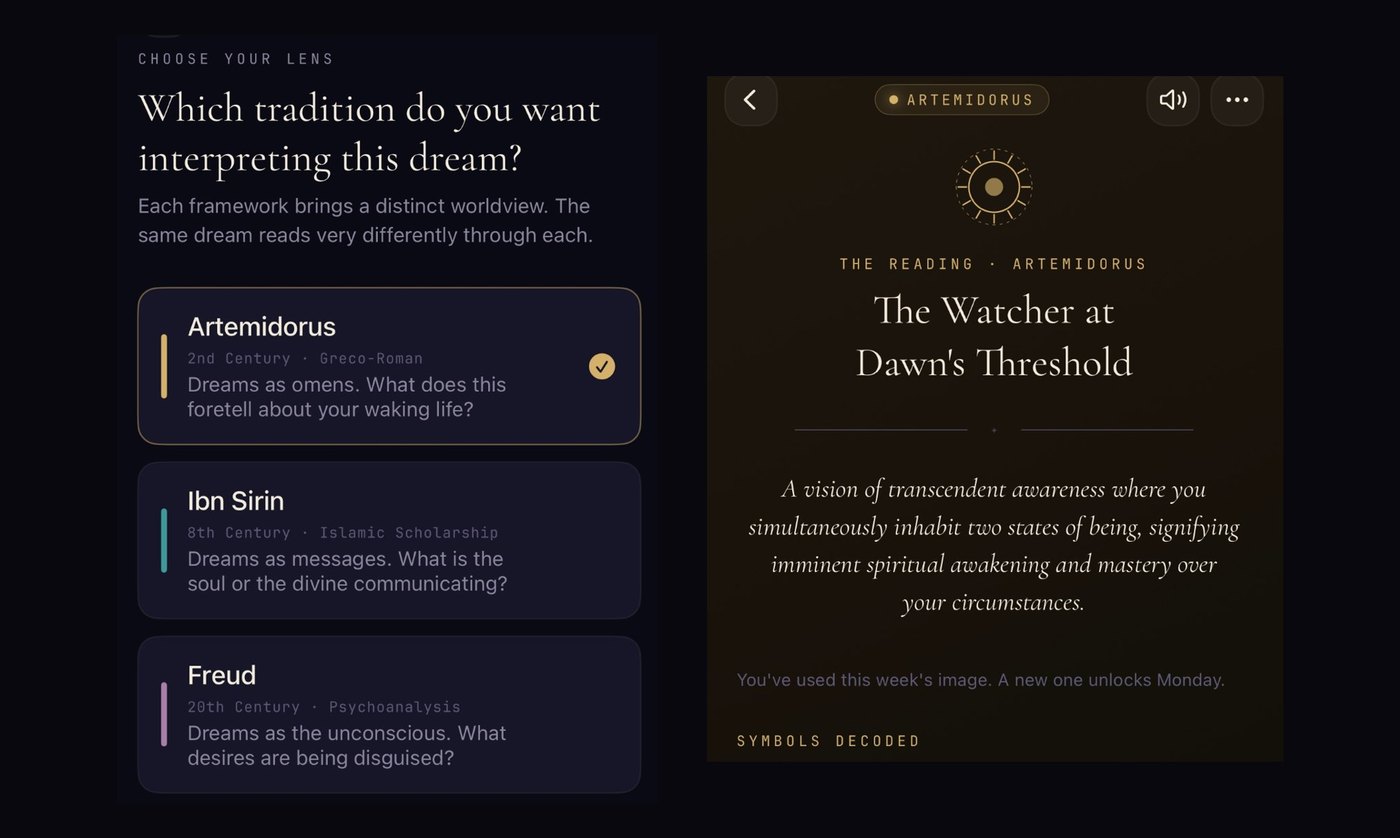
The three buttons are the same size. The sources behind them are not. Artemidorus’s Oneirocritica, written around 180 to 210 CE, is the only text surviving from antiquity that teaches readers to predict the future from dreams. Ibn Sirin, a scholar who died in Basra in 729, is the name attached to the Great Book of Interpretation of Dreams, though that book was compiled in the fifteenth century and his authorship is disputed. Ruyay, an Islamic dream app, is careful to call it the book attributed to Ibn Sirin.
Dream dictionaries used to give one answer per symbol, and some popular apps still merge several traditions into a single verdict. A long-running Chinese dream app, on the App Store since 2014 with more than 20,000 ratings, promises to blend the Zhou Gong dream book with Freud’s The Interpretation of Dreams into what it calls the most scientific and reasonable answer. The newer apps leave the blending to the user. Noctura’s store copy invites users to read whichever version resonates, or all three. Onifide presents each reading as one symbolic framework’s view, never a truth, a forecast or a verdict. Zhou Gong, the ancient Chinese statesman whose name has long been attached to a traditional dream dictionary, turns up in Dream Sage sharing a single “Eastern” tile with Hindu and Buddhist wisdom.
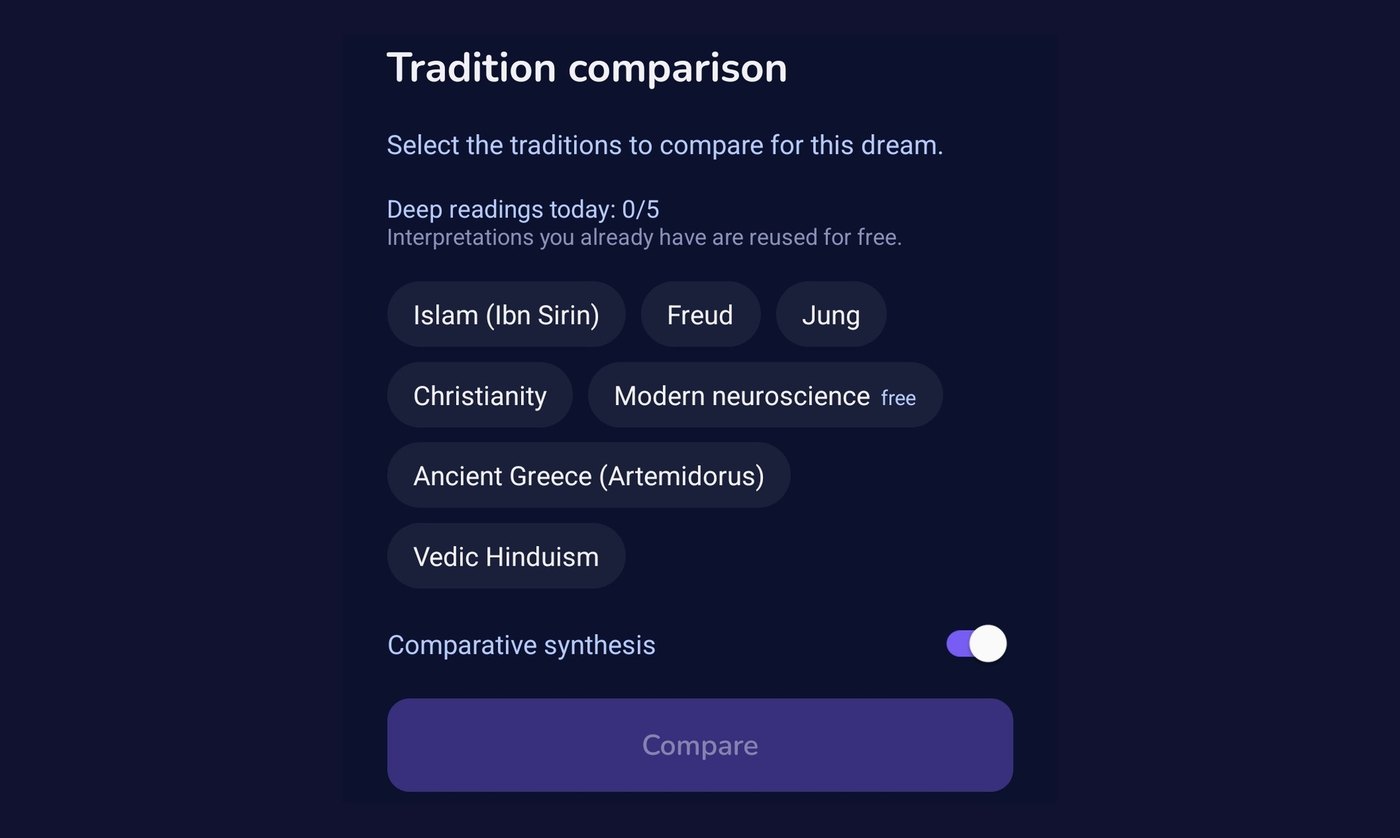
Once readings come in tabs, pricing follows the tabs. Noctura’s version 1.1.0, released on August 12, spelled out the new rules: your first dream gets all three interpretations; after that, free dreams include only the psychological reading, while the Islamic and spiritual lenses became part of Premium. Voice recording moved behind the paywall too, though typing a dream stays free. On Onifide’s comparison screen, which counts down five deep readings a day, one of the seven lenses carries a free label: modern neuroscience. In both apps, the reading you get for nothing is the one furthest from faith. From the second dream on, hearing what Ibn Sirin would say costs money in Noctura.
In Arabic-language apps, choosing a tradition often means choosing an interpreter. One Google Play app, whose Arabic name translates as “Dream Interpretation by Ibn Sirin and AI,” offers three AI interpreters named after classical dream scholars: Ibn Sirin, Abd al-Ghani al-Nabulsi and Ibn Shahin. Its Arabic description invites users to pick the interpreter their heart feels at ease with. Before interpreting, it asks for the dreamer’s gender, age and marital status, and when the dream came: before the dawn prayer, after it, in the afternoon or in the evening. Every detail, the form warns, may change the meaning of the interpretation.
In its screenshots, Ibn Sirin’s portrait sits at the top of a chat window next to a green dot and the words “ready to interpret.” The sample message, about a dream in which an ex-fiancé asks the dreamer to wear his ring, shows two check marks and the word received. Then a bubble appears: “Ibn Sirin is typing…” A scholar who died nearly 1,300 years ago now has an online status.
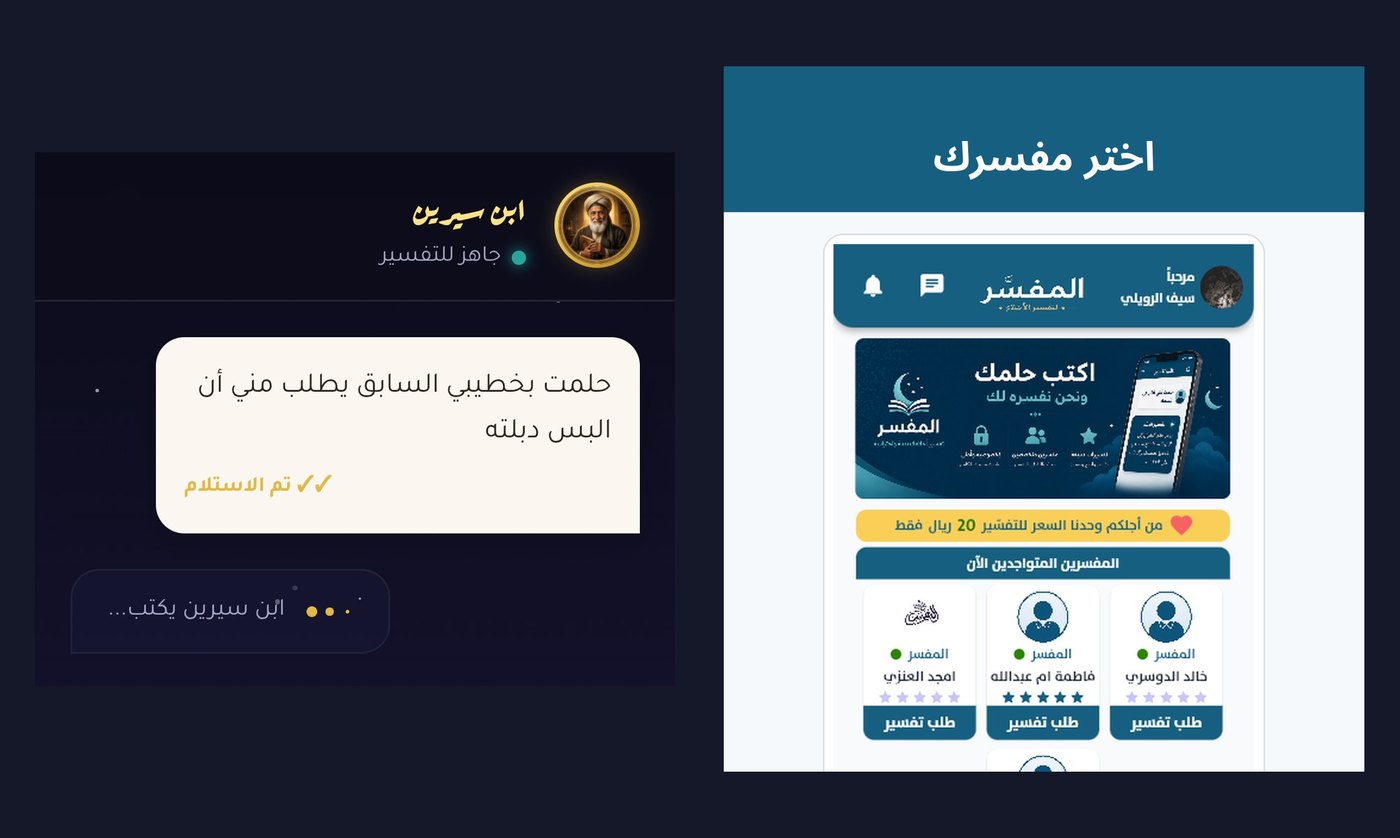
Al-Mufassir, released on September 15, hands the choice back to people. Its first store screenshot is headed “Choose your interpreter” and shows human interpreters who are online now, each with a star rating and a button to request a reading. A banner sets a flat price of 20 riyals per interpretation. Answers arrive as text or audio, and users can keep chatting in the app. The listing adds that each interpretation reflects the interpreter’s own judgment, is not a prediction of the future, and does not replace medical, psychological, legal or financial advice.
Wherever Islamic tradition appears, the qualifications multiply. Noctura says its Islamic readings respect the source texts and issue no fatwas. Ahlami says it does not treat dreams as predictions, divine guarantees or religious rulings. Ruyay records whether a dream came before the dawn prayer, and every reading ends with the words “and Allah knows best.”
Back on Noctura’s glowing shore, the grandmother goes by a different name in each tab’s list of key symbols: grandmother, matriarch, feminine lineage. Whether she brings blessing, an archetype or ancestral support, the app does not decide. All three screens end with the same button: Save.
Related apps
 Noctura: Dream JournalUseful for people who want one place to record dreams and read a quick AI-supported interpretation.
 Uyanış: Rüya YorumlamaUyanış is an AI dream journal with voice and text entry and several interpretive perspectives.
 Onifide: Dream InterpretationChoose Jung, Freud, Ibn Sirin and other traditions for the same dream.
 Dream Sage: AI InterpretationUseful for people who want one place to record dreams and read a quick AI-supported interpretation.
 Mythos - Dream JournalUseful for people who want one place to record dreams and read a quick AI-supported interpretation.
 Islamic Dream InterpretationFor Muslim readers who want dream meanings traced to the classical books.
 周公解梦 - 大师测算解梦全书大全Useful for people who want one place to record dreams and read a quick AI-supported interpretation.
 تفسير الأحلام لابن سيرين و AIAI dream readings offer Ibn Sirin, al-Nabulsi and Ibn Shahin approaches.
 المفسّرAl-Mufassir connects people with human dream interpreters.
 Ahlami: Islamic Dream JournalFor dreamers who want reflections informed by Islamic tradition.
Recommended
 FateKitSponsoredBest for astrology and Chinese-metaphysics readers who want to compare several chart systems for the same moment, inspect the sky data behind them, and prepare structured context for an external AI without uploading a profile by default.
 Cantian AIFor people who want AI Bazi readings and also want to cast a hexagram, check feng shui, or choose a name in the same app.
Sources
- App StoreNoctura on the App Store
- App StoreUyanış on the App Store
- Google PlayOnifide on Google Play
- App StoreDream Sage on the App Store
- App StoreMythos on the App Store
- Oxford University PressOxford University Press on the Oneirocritica
- WikipediaGreat Book of Interpretation of Dreams
- Google PlayIbn Sirin AI dream app on Google Play
- Google PlayAl-Mufassir on Google Play
- App StoreAhlami on the App Store
- App StoreRuyay on the App Store
Similar stories
An AI Reads Your Turkish Coffee Cup in Seconds. The Human Readers Make You Wait
Turkey's coffee cup reading apps have long sent your photos to human readers, and reviews complain about hours of waiting and stock phrases. Telveden lets AI read the grounds in seconds, publishes its 85-shape atlas and sources, and admits a different model would see different shapes.
AI DivinationAI metaphysics products
This Dream App May Sell Your Dreams to AI Developers, If You Say Yes
DreamApp's July 21 privacy update lets it train its own models on dream content and, with opt-in consent, license or sell dream datasets to AI developers; withdrawing can't recall copies already delivered. A few small apps are moving readings onto the phone instead, with trade-offs.
AI Dream JournalRisk and trust
Tarot Is Common Among Young Americans. Asking AI for Spiritual Guidance Isn't
A Harris Poll survey finds 30% of Gen Z and Millennials regularly did astrology or tarot in the past year. An NPR/Ipsos poll finds only 11% of AI users have asked AI for spiritual or religious guidance, and 69% say they never would. Neither survey asked whether the card-pullers use AI.
AI DivinationAI Tarot