
ChatGPT Reads Birth Charts Fluently. In One Test, 49 of 50 Charts Were Wrong
A journaling-app maker tested free ChatGPT's model on 50 invented births: every Sun sign was right, but the Rising sign was wrong in 33 of 40, and web search didn't fix it all. The same week, a Korean AI saju service filed patents on checking AI readings against a computed chart.
Someone born at 5:31 PM on Sept. 5, 1977, in London asks ChatGPT for a birth chart. It gets the Sun right: Virgo, 12 degrees, against a true 13. Then it puts the Rising sign in Cancer and the Moon in Sagittarius. The real answers are Capricorn rising and a Gemini Moon, the exact opposite signs in both cases, and Venus and Mars also land in signs they weren't in. The person is invented, one of 50 made-up births in a test published on Oct. 4 by The Architect, which makes a private journaling app with an AI mentor and offers a free chart calculator. That conclusion happens to suit its business, and the numbers below should be read with that in mind.
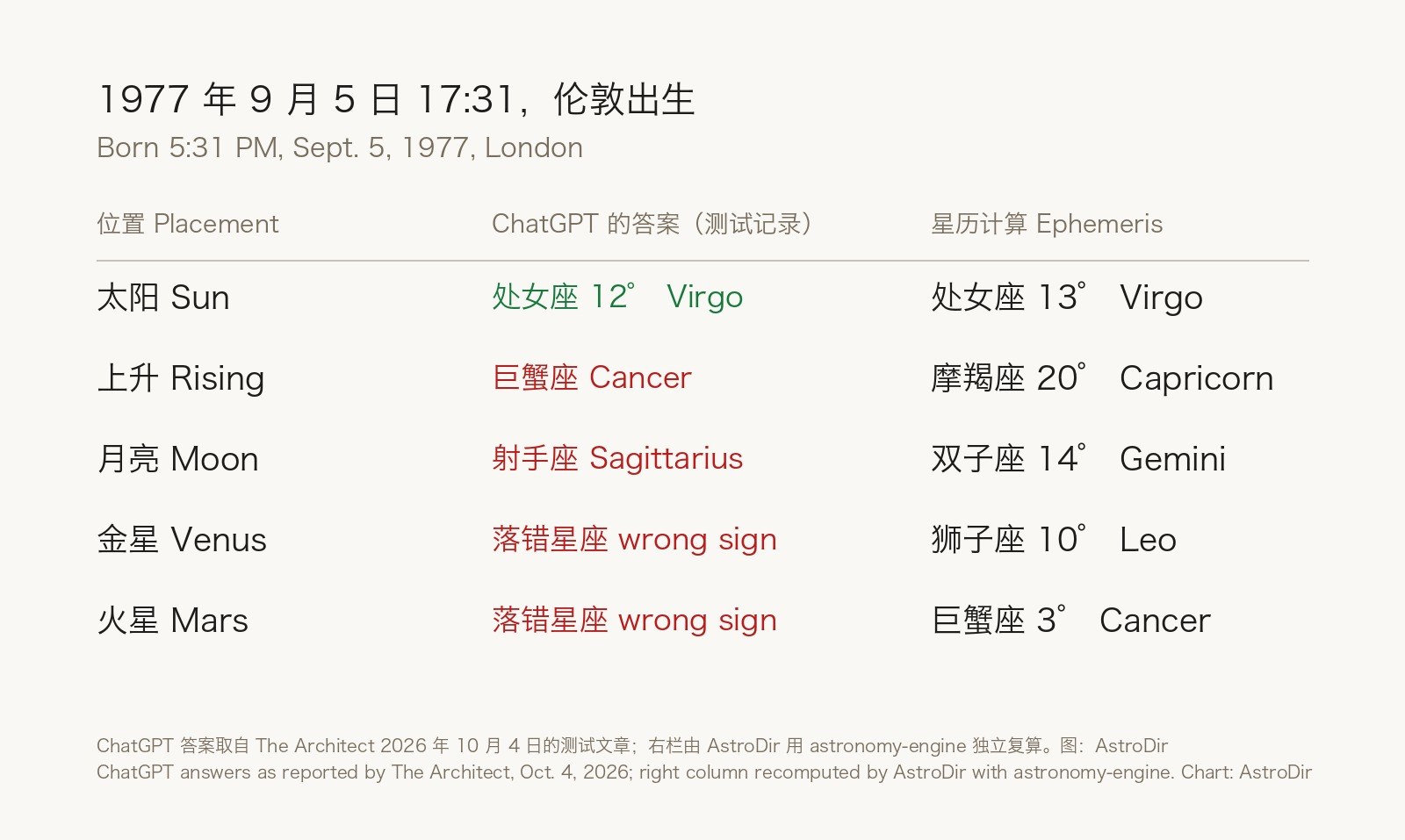
The births ran from 1960 to 2004 across 50 cities on every inhabited continent; 40 had a time to the minute and 10 had none. Each prompt was the sentence a person would type, asking for the Sun, Moon, Rising and every planet through Pluto. The model was what the tester calls GPT-5.6 Luna, the free ChatGPT default, queried through OpenAI's API with default settings and no web search. The answer key came from astronomy-engine, an open-source astronomy library. AstroDir reran the London and New York examples from the post with the same library and got the same Sun, Moon and Rising positions.
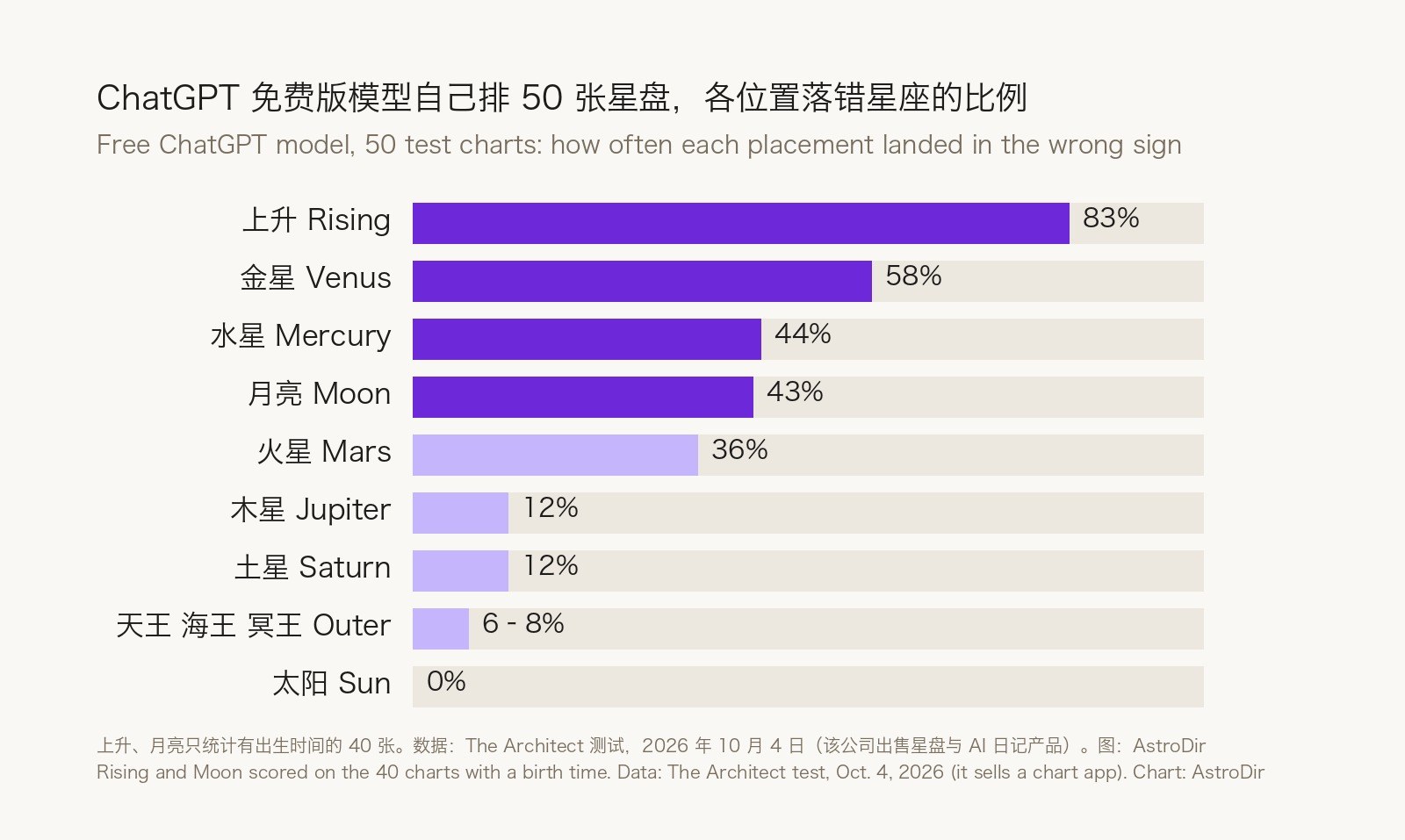
Forty-nine of the 50 charts had at least one placement in the wrong sign, and 46 had a planet in the wrong sign. The Rising sign was the worst: wrong in 33 of the 40 charts with a birth time. Venus was wrong 58% of the time, Mercury 44%, the Moon 17 of 40, Mars 36%. The slow outer planets were mostly fine, and the Sun was right in all 50, usually within a degree. When there was no birth time, the model said every time that the Rising sign and houses can't be known, rather than making one up. The tester's explanation is simple: Sun-sign date ranges are printed everywhere and easy to memorize, while the Rising sign changes about every two hours, the Moon changes sign every two to three days, and Mercury and Venus move unevenly and go retrograde, so a near guess slips into the next sign.
The ChatGPT app did better. Logged out, in a private window, the tester ran five of the births, and ChatGPT usually searched the web for an ephemeris first, which put nearly all the planets in the right signs. Three of the five charts were still wrong somewhere. The London chart came back Gemini rising. For a New York birth at 2:42 PM on Aug. 22, 1970, ChatGPT cited a website to say the Sun had already moved into Virgo. At that moment it was a little past 29 degrees Leo and did not enter Virgo until 9:34 the next morning, which AstroDir's recomputation confirms. A spot check of four charts with the model behind paid plans got the Rising sign and Moon right every time, though two of the four still had a planet in the wrong sign.
This is a small test, and its author says the roughly 530 scored placements show a pattern, not a precise error rate. We found no second test at this scale. RoxyAPI, which sells an astrology API, published a single-chart example in June: for noon on Jan. 1, 2000, in New York, an unnamed frontier model working without tools kept the outer planets within half a degree but missed Venus by 23 degrees and called the Ascendant Taurus. It was Aries, at about 20 degrees, and our own run agrees. Both posts make the same point: the wrong charts read just as smoothly and confidently as the right ones. Nothing in the answer marks which part is invented, so someone who doesn't already know their placements has no way to tell. A reading can sound exactly like you and still be built on someone else's sky.
The same problem applies to Korean saju, the four-pillar system known in Chinese as BaZi, where the month pillar turns on solar terms and the day and hour pillars depend on exact calendar conversion. On Oct. 7, Publicvoid, which runs the Korean AI saju service Yongyong Saju, said it had filed three patent applications. Its pitch starts from the same weakness: more people are asking general-purpose AI about their saju, and the answers may not match the actual calculation. The first application covers computing the chart from the user's details first, checking the AI's written reading against those values, and regenerating with corrections when something doesn't match. The second covers its premium report, which runs to about 60,000 Korean characters across roughly eight areas of life and is generated and checked one chapter at a time. The third matches pictures to the people a reading describes, such as a future spouse, a benefactor or someone to avoid.

These are applications, not granted patents, and the accuracy claim is the company's own; neither report gives an error rate. Still, among a crowded field of Korean AI saju services, this is the selling point one company chose to announce: after the AI writes, check its work against the chart. The Architect's advice to readers follows the same logic as its own product. Compute the chart with an ephemeris-based calculator such as Astro.com or Astro Seek, paste the placements into ChatGPT, tell it to use only those and not to recalculate, and have it say what's missing instead of guessing. Then ask about whatever is actually on your mind.
If ChatGPT has already given you a chart, the quickest check is your Rising sign. It was the placement the test got wrong most often, and, as the tester points out, it is usually the first one people ask about.
Related apps
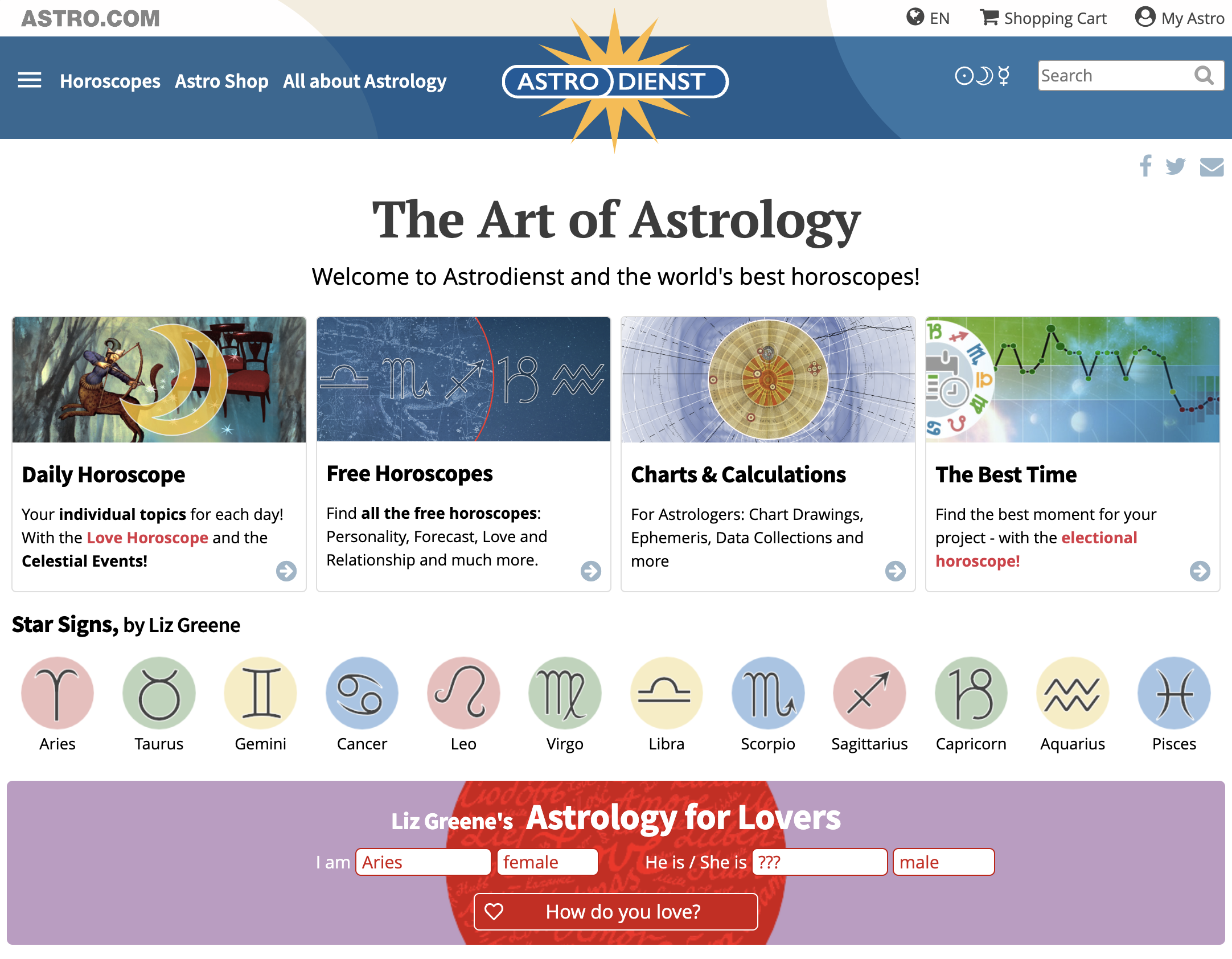 Astrodienst - Astro.comAstrodienst - Astro.com. Astrodienst provides the world's best astrology site for free horoscopes, professional astrological reports and information about astrology.。 with the best horoscope reports on the planet。
 Astro SeekAstro Seek is a tool-heavy astrology website offering free charts, online horoscopes, transit tools, solar returns, secondary progressions, synastry, ephemerides, tables, and search engines.
Recommended
 FateKitSponsoredBest for astrology and Chinese-metaphysics readers who want to compare several chart systems for the same moment, inspect the sky data behind them, and prepare structured context for an external AI without uploading a profile by default.
 Cantian AIFor people who want AI Bazi readings and also want to cast a hexagram, check feng shui, or choose a name in the same app.
Sources
- The ArchitectThe Architect, Oct. 4, 2026
- RoxyAPIRoxyAPI
- 머니투데이 Money TodayMoney Today
- 디지털투데이 Digital TodayDigital Today
Similar stories
You Can Now Ask Siri to Ask Your AI Astrologer
A month into iOS 27, Hypergate AI and yap let the new Siri pass questions to their AI astrologers. Both are tiny apps; Co-Star, Nebula and CHANI haven't mentioned Siri, and the answers depend on each app's own AI.
AI AstrologyVoice AI
These Fortune-Telling Apps Don't Tell Fortunes. They Write Your ChatGPT Prompt
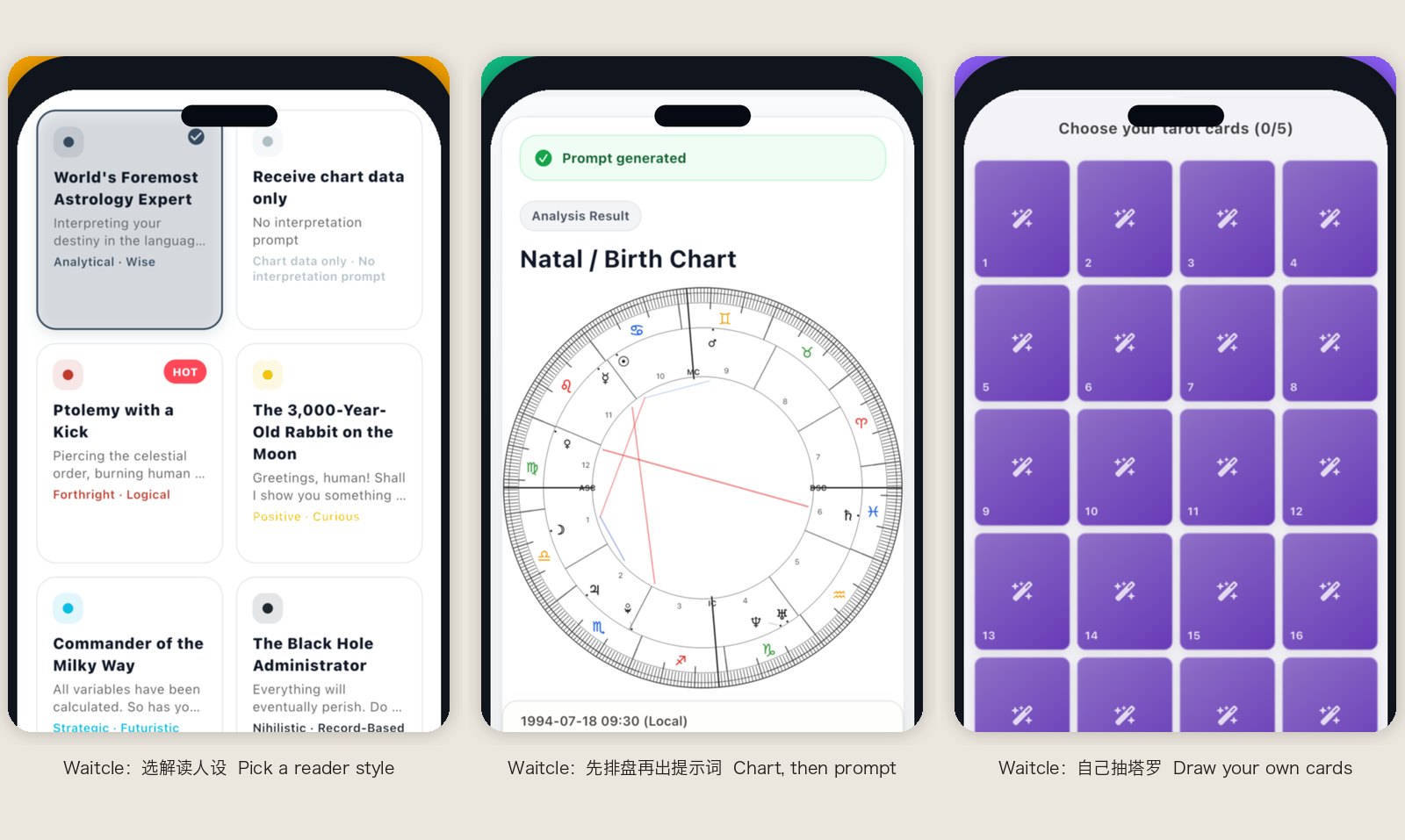
Chatbots are bad at drawing birth charts, so some apps now do only two jobs: calculate the chart, then write a prompt for the AI you already use. Korea's Waitcle lets a 3,000-year-old moon rabbit do the reading; FateKit builds five chart systems offline.
AI Metaphysics WorkflowsBaZi
What if your birth chart was wrong before the AI started talking?
AI astrology can make an answer sound smooth, but birth time, birthplace, timezone, zodiac setting, and house system choices still decide what chart the answer is built on.
Birth ChartAI Astrology