
The breakup app now sits before the send button
UpBreak, Choose Me, Growth, and No Contact Tracker AI point to a small but sharp product shift: breakup apps are moving into the minutes before someone texts an ex.
The riskiest text is already written
At three in the morning, the hard part is not always the crying. It is the open message box.
The text is already there. It may be a small "are you awake?" or a long explanation that has been rewritten ten times. The person knows sending it may make things worse, but the thumb is still near the button. A small group of breakup apps is being built for that exact pause.
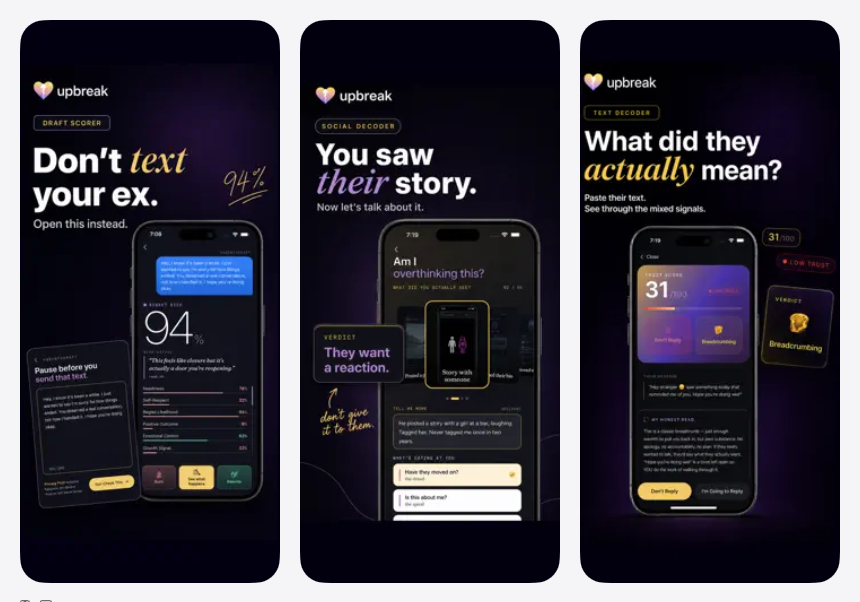
UpBreak states the use case almost too plainly: you are about to text your ex, and you know you probably should not. The app lets the user draft the message first, then gives a regret-risk score before it leaves the phone. It also offers message decoding for incoming texts, social decoding for the spiral that follows checking an ex's posts, no-contact tracking, breathing tools, and an AI breakup coach that remembers the user's story.
That is why the product is interesting. It is not selling heartbreak as a soft lifestyle mood. It admits something messier: people do reach for their phones when their judgment is at its weakest.
This is not ordinary journaling
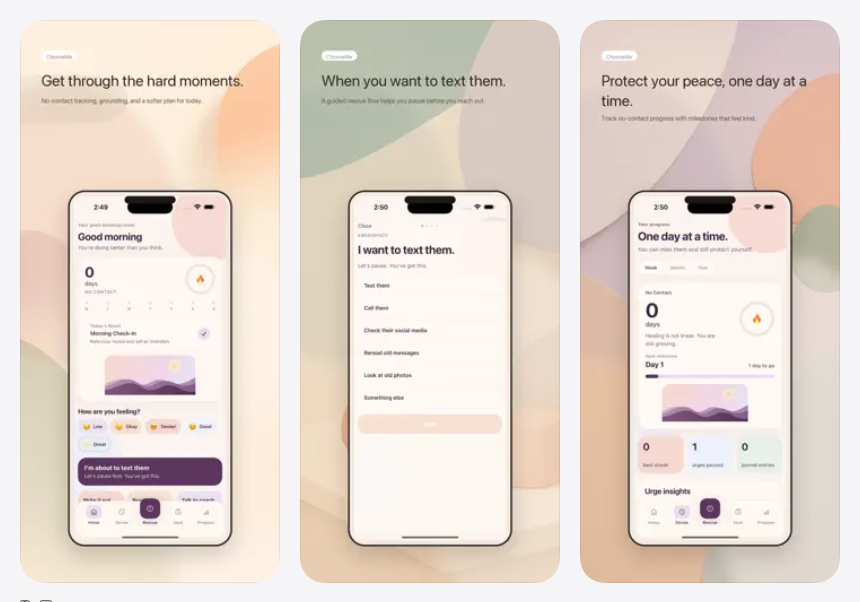
Choose Me works in the same emotional territory, with a quieter tone.
Its App Store listing brings no-contact tracking, rescue mode, mood check-ins, a daily plan, private notes, unsent letters, and red-flag reminders into one place. The paid layer adds unlimited journaling, AI coach conversations, and AI reflections on notes, letters, and red flags. The page also says the app is not professional therapy or crisis intervention, and directs people in urgent mental-health situations to 988 or local emergency services.
That disclaimer matters. The content here is not light. A user may write anger, bargaining, shame, revenge, longing, or the small humiliating sentence they would not say out loud. AI in this setting is not a productivity feature. It is entering a moment when a person may be unusually persuadable.
The phone gets a buffer
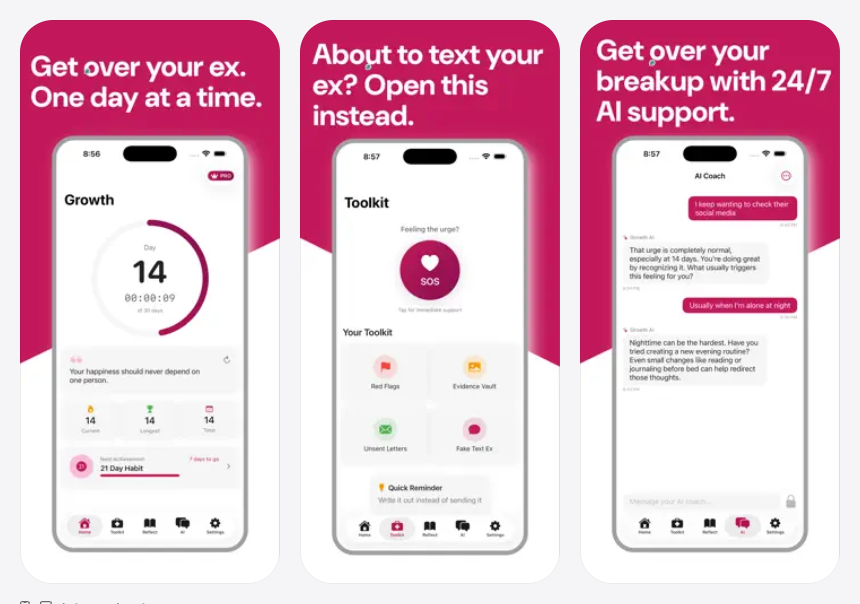
Growth is closer to an emergency kit.
It has a no-contact timer and an SOS button. When the user is about to break the streak, the app walks them through a five-step flow: breathing, a personal affirmation, a red-flags list, an evidence vault, and a safe outlet. It also includes a fake text feature, letting the user type into an iMessage-like screen without sending anything.
That sounds odd until you think about the real behavior. Sometimes the person does not need communication. They need somewhere for the impulse to go.
No Contact Tracker AI turns the same idea into habit management. It counts hours, minutes, and seconds, lets users reset progress, and analyzes triggers. The AI coach can take a softer or more direct tone. The app also includes Brain Shield, an SOS panic button, an unsent-letters vault, and more than 40 guided exercises. Its listing frames the product as self-help journaling and habit tracking, not medical or therapeutic advice.
The market depends on repetition
Put these products together and the category becomes clearer. Breakup recovery apps are no longer only journals, affirmations, or meditation libraries. They are starting to handle specific actions: do not send the message, do not check the post, do not hand an entire night of emotion to a send button.
The category can work because breakup pain repeats. A user may face the same problem every day. They want to contact, look, explain, prove they are not losing. A normal journal app can store the feeling. A general chatbot may follow the user's emotion too easily. A no-contact app narrows the goal: do not send it tonight, get through today, decide later.
There is also a thin risk line here. The better the product becomes at stopping someone, the more it can feel like a portable authority. It can remind the user to pause, hold an unsent letter, or bring back a list of red flags. It should not decide the meaning of the relationship for them. It should not treat every moment of looking back as failure.
A May 5 arXiv paper makes the direction worth watching. Researchers tested a single-session AI chatbot intervention for breakup distress with 254 adults in the US and UK. Participants who used the chatbot showed a larger drop in breakup distress after seven days, with a smaller advantage still present after one month. That does not mean AI can fix heartbreak. It does suggest that a short, timely, specific intervention can be acceptable to people in the aftermath of a breakup.
The business tension is obvious. A breakup recovery product is not healthier because it keeps the user forever. In the best version, the app eventually becomes less important. That is a hard subscription story. Retention wants people to stay; recovery asks them to leave.
So the most interesting part of this niche is not whether the AI can write warmer comfort. It is that "do not send that text" is becoming a complete product surface: the pause before the impulse, the draft that never leaves, the visible count of days, the late-night breathing exercise, the small daily check-in.
After a breakup, the phone is already dangerous. These apps are trying to place a buffer in front of the send button.
Related apps
 UpBreakUpBreak. Free to start. Your brain is in withdrawal.
 Choose MeChoose Me. Free in the app:.
 GrowthGrowth. Type out what you'd say in an iMessage-style chat that never sends Breathing Exercise. Save photos as a reality check for weak moments Unsent Letters.
 No Contact Tracker AITrack your hours, minutes, and seconds of freedom. DAILY DETOX & EMOTIONAL JOURNALING Turn your pain into power with guided introspection.
Recommended
 Cantian AIFor people who want AI Bazi readings and also want to cast a hexagram, check feng shui, or choose a name in the same app.
 FateKitSponsoredBest for astrology and Chinese-metaphysics readers who want to compare several chart systems for the same moment, inspect the sky data behind them, and prepare structured context for an external AI without uploading a profile by default.
Sources
Similar stories
The App That Scores Your LINE Chats Now Pulls Tarot Cards
Merotalk, a Japanese app that scores relationships from LINE chats, added AI-read tarot in October, and its developer helped the 100-million-take Love Type Diagnosis quiz launch a daily love fortune slip. A quiz is taken once; a fortune can be drawn every day.
AI Relationship SupportAI Tarot
Hesitate, and This AI Cat May Suggest a Tarot Reading
Japanese companion app Meowster gave its chat cat a tarot deck in September. When it senses you are torn, the cat may offer a three-card reading with no redraws; the basic reading is free and a detailed report costs ¥100. Fine as a toy, but what you confide next goes to model providers and is kept for three years.
AI TarotRisk and trust
An AI Astrology App Rewrote Its Terms. Think Before You Add Your Friends
Lora launched on September 14 as a free app with no in-app purchases. On September 30 it rewrote its terms: some features now need a subscription, its chats are generated by unnamed third-party AI models, and it can sync your contacts. Its main feature asks you to add partners, family and coworkers.
AI AstrologyRisk and trust