
Tarot Is Common Among Young Americans. Asking AI for Spiritual Guidance Isn't
A Harris Poll survey finds 30% of Gen Z and Millennials regularly did astrology or tarot in the past year. An NPR/Ipsos poll finds only 11% of AI users have asked AI for spiritual or religious guidance, and 69% say they never would. Neither survey asked whether the card-pullers use AI.
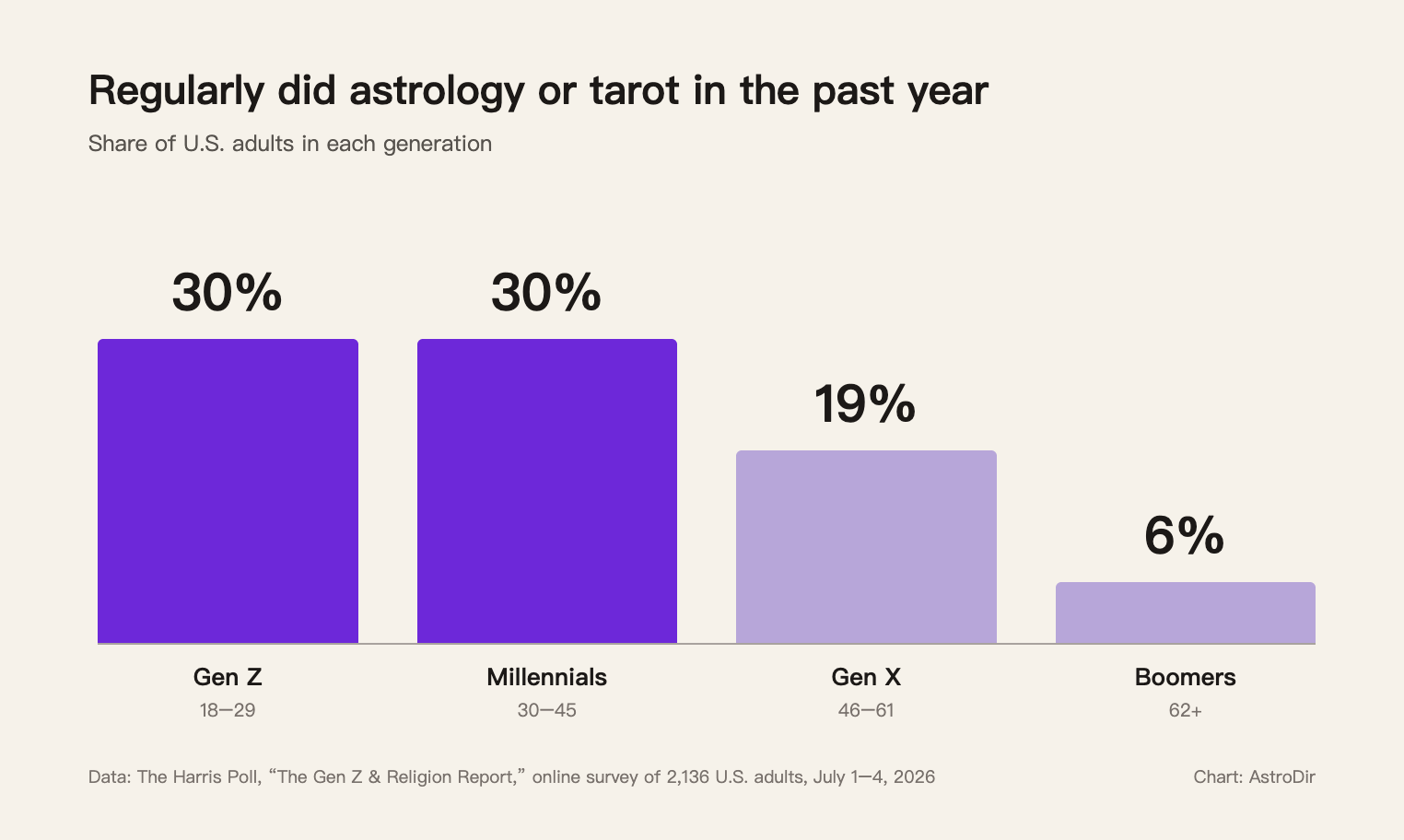
Between July 1 and 4, 2026, The Harris Poll surveyed 2,136 U.S. adults online, including 372 members of Gen Z aged 18 to 29. Its Gen Z & Religion Report, released in September, asked which practices people had done regularly in the past year. One option was "astrology or tarot," with reading charts and pulling cards given as examples. Gen Z and Millennials (30 to 45) both came in at 30%. Gen X (46 to 61) was at 19%, and Boomers (62 and older) at 6%.
The report's headline finding is about religion, and it cuts against the usual story. Gen Z was the generation most likely to call itself religious, at 33%, against 19% of Millennials, and it reported reading scripture and attending services more often than Boomers did. Astrology and tarot sit alongside that rather than replacing it. In the same survey, 51% of Gen Z said they regularly meditate or practice a ritual, 49% practice manifestation, and 32% do energy work such as reiki or crystals.
There is no shortage of apps offering AI tarot spreads and AI birth chart readings. So the obvious next question is whether the people pulling cards are handing these questions to a chatbot.
A second survey, released in late September by NPR and Ipsos, gets partway there. Ipsos polled 1,011 adults from August 7 to 9 using its probability-based KnowledgePanel, with a margin of error of plus or minus 3.6 points. Sixty-one percent had used a tool like ChatGPT, Gemini or Claude. Among those 643 AI users, 11% had sought spiritual or religious guidance from AI, and 5% said they currently do. Another 19% had not but were open to it, and 69% said they never would. NPR puts the share of all Americans at 6%, noting that this is roughly the combined share of Jews, Muslims, Hindus and Buddhists in the U.S.
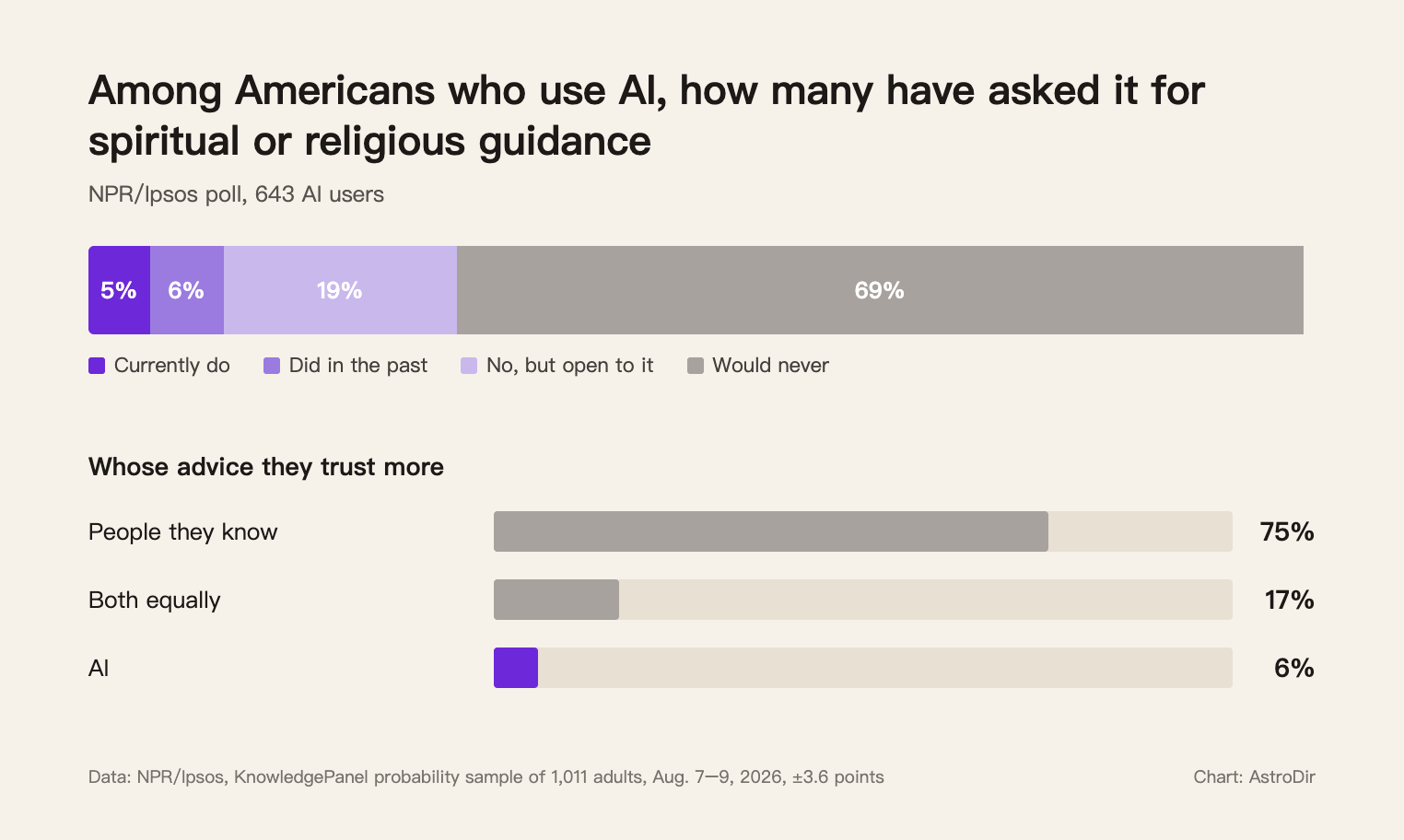
On personal matters, AI users still lean on people. Three in four said they trust advice from people they know more than advice from AI; 6% said the reverse. Asked why they might pick AI over a person for a difficult topic, the top answers were practical: it is available anytime without scheduling or waiting (31%), and it knows more than the people they could ask (29%). Not being judged came next at 23%, and being able to be more honest with AI than with people they know at 18%. Nearly half, 47%, said they would not turn to AI for that kind of topic at all. Ipsos also notes that those who do use AI for spiritual guidance skew lower-income and less educated, and that adults 65 and older are notably less likely than those aged 35 to 49 to use it this way.
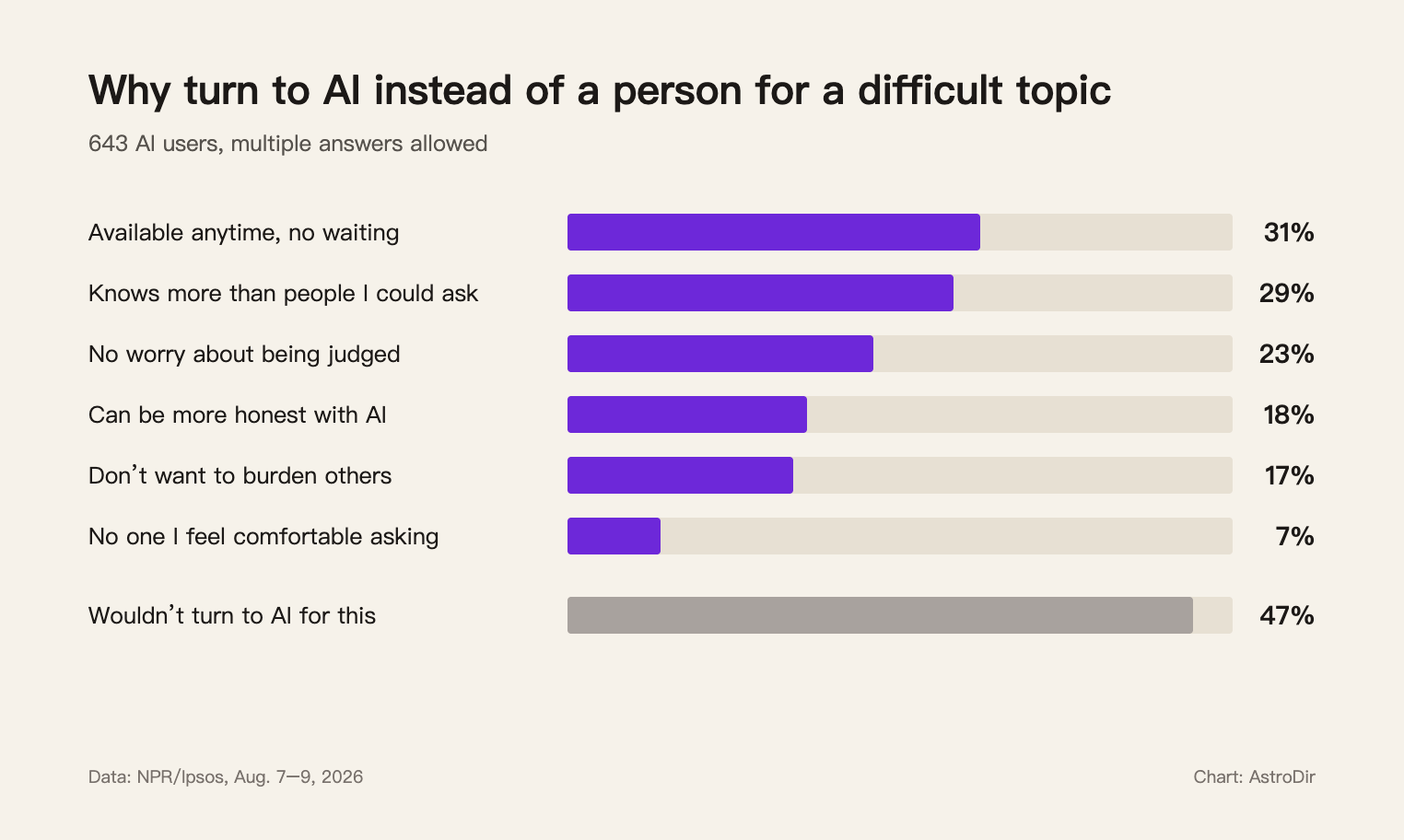
Read together, the two surveys answer part of the question clearly. Regular astrology and tarot are common among Americans under 46, while bringing spiritual questions to AI is still a minority habit. The minority who would use AI point to an answer at 2 a.m., a wider store of information, and not being looked down on. None of the listed reasons is about AI understanding their fate better, and the answers read more like people using an always-open reference desk.
The gap is in what neither survey asked. The spiritual items in the Ipsos questionnaire take all their examples from organized religion: Bible study, writing prayers, going to a pastor, priest, rabbi or imam. Astrology and tarot never appear, so whether someone who has an app interpret their cards would tick "spiritual guidance" depends on how they read the phrase. Harris asked about astrology and tarot but not about the tools, so a physical deck, a human astrologer and an app all count toward the same 30%. How many of those people already paste their birth chart into ChatGPT is a number no national poll has produced yet. Until one does, NPR's 6% describes Americans asking AI about faith, not Americans asking it to read their stars.
Recommended
 FateKitSponsoredBest for astrology and Chinese-metaphysics readers who want to compare several chart systems for the same moment, inspect the sky data behind them, and prepare structured context for an external AI without uploading a profile by default.
 Cantian AIFor people who want AI Bazi readings and also want to cast a hexagram, check feng shui, or choose a name in the same app.
Sources
- The Harris PollThe Harris Poll, The Gen Z & Religion Report
- NPRNPR
- IpsosIpsos topline
- IpsosIpsos release
Similar stories
This AI Astrology App Thought It Was Still 2023. Now It's Back
SINE shipped version 2.0 on Oct. 15, its first update since December 2024, with a new backend and tarot readings matched to the cards drawn. While it sat untouched, reviewers said its AI read their transits for October 2023, then the app stopped loading altogether.
AI AstrologyAI Tarot
An AI Reads Your Turkish Coffee Cup in Seconds. The Human Readers Make You Wait
Turkey's coffee cup reading apps have long sent your photos to human readers, and reviews complain about hours of waiting and stock phrases. Telveden lets AI read the grounds in seconds, publishes its 85-shape atlas and sources, and admits a different model would see different shapes.
AI DivinationAI metaphysics products
Hesitate, and This AI Cat May Suggest a Tarot Reading
Japanese companion app Meowster gave its chat cat a tarot deck in September. When it senses you are torn, the cat may offer a three-card reading with no redraws; the basic reading is free and a detailed report costs ¥100. Fine as a toy, but what you confide next goes to model providers and is kept for three years.
AI TarotRisk and trust