
This App's White-Haired Fortune-Teller Is an AI
On Oct. 1, the Japanese app Uracchi switched readings from per-minute to per-character billing, the meter Japan's human chat-reading services use. Its readers have names, faces and timers, and the store listing never says AI, though the company's terms and funding announcements do. Some reviewers thought they were talking to people.
In the App Store screenshots for Uracchi, a Japanese fortune-telling app, a reader named Sumiko Aihara is mid-session. Her avatar is a white-haired older woman in a gold necklace, a fan of tarot cards in her hand, and a timer beside her name reads 01:20:30. She tells the user she can see three paths ahead and asks which one they will take. The store listing invites you to pick a fortune-teller and browse their profiles for free, and the official website says the app's mascot will introduce you to one. Neither mentions AI. The terms of service from the developer, Kiminotonarino Inc., are plainer: the service uses AI and algorithms to give users advice.
On Oct. 1, Uracchi shipped version 2.2026.1001. Apart from the usual thanks, the release notes say one thing: readings are no longer billed by time but by the number of characters. The old timer shows up in reviews. In June, one user wrote that they had bought a five-minute extension for 250 coins near the end of a free reading, only to get an error saying the extension had failed. Another said last December that the screen froze the moment their time ran out.
Per-character billing is how Japan's human chat-reading apps have long charged. Uranow's listing says readings start at 2 points, or 2 yen, per character, counted on messages in both directions. Juju lists 6 points per character and up. Uranai Stella, which says more than 1,000 fortune-tellers are on call, promises no time limit and deducts points by character count. Uracchi now runs on the same meter. What it charges per character, and whose characters count, is not in the release notes, the store page or the terms. We did not buy coins, so we can't say whether the change makes a reading cheaper or dearer.
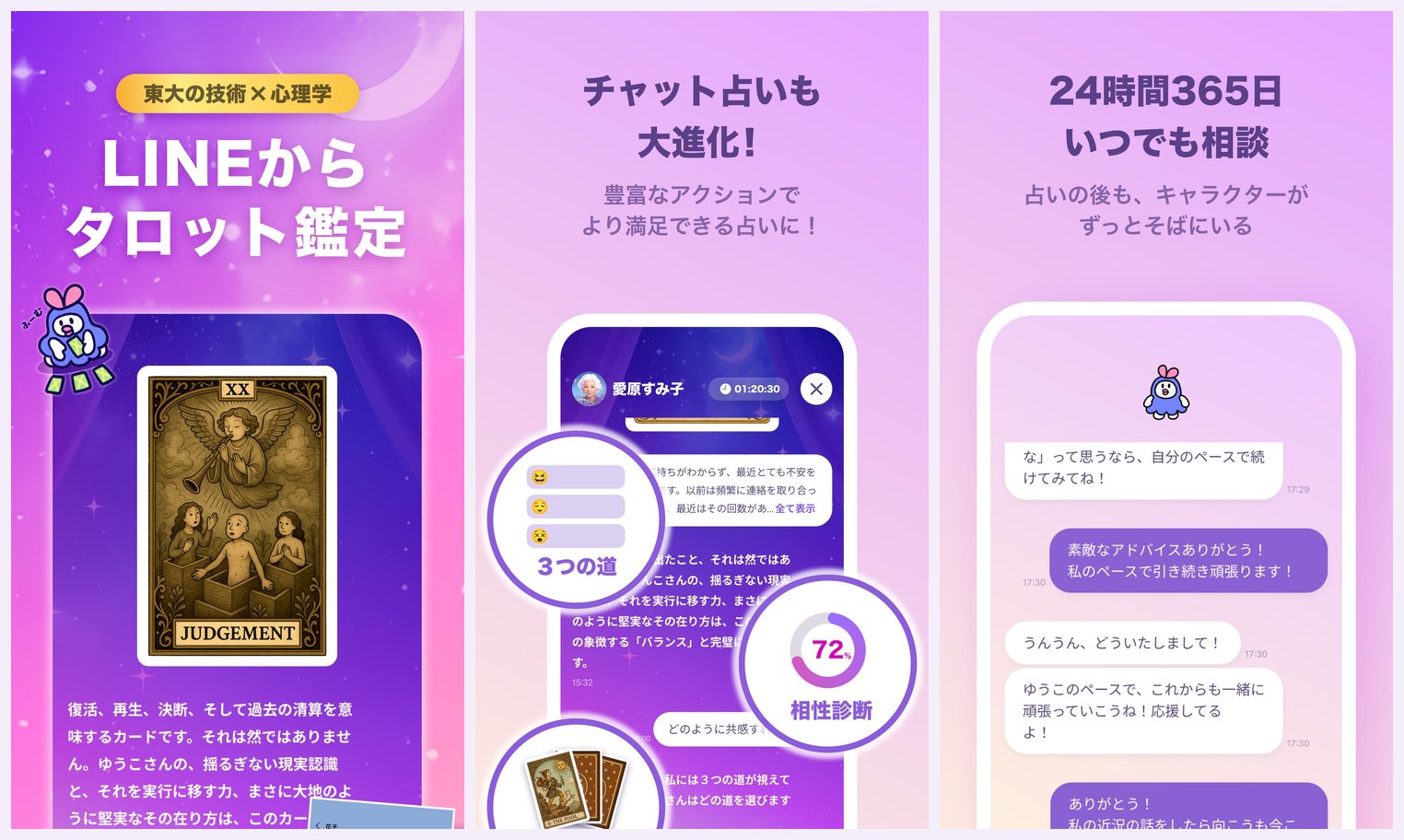
The company started out by attacking exactly this kind of pricing. Its launch announcement on Sept. 16, 2025, listed four problems with traditional fortune-telling. One was expensive per-minute billing that keeps clients watching the clock instead of saying what is really bothering them. Another was "fortune-teller gacha," the luck of the draw in a reader's skill, which it promised to fix with a model built on University of Tokyo technology. The same release says it is an AI fortune-teller that reads the user's LINE chats. A year on, the timer is gone, replaced by the other meter human chat services use, and you still start by choosing a reader.
The company is open about AI when it talks to investors. A November 2025 seed announcement put total funding at 72 million yen and said subscribers averaged 12.25 readings a month. On Sept. 2, 2026, it announced a Series A worth several hundred million yen. The first line of the release graphic describes the business as an AI fortune-telling app, and the graphic claims monthly revenue growing 75% on average and one in four active users paying. Those figures are the company's own.

Users, who see only the storefront, have been left to work it out. A four-star reviewer in December said the free session felt caring, but admitted they weren't up on new technology and couldn't tell whether it was AI. A one-star review in May called it an app that just funnels you to fortune-tellers and complained about having to choose one first, which reads like someone who assumed the readers were human. In September, one user concluded it was AI relationship advice and fine for sorting out their thoughts; three days later, another said they wanted a person, not an AI, and wouldn't pay. Back in March, someone had already decided it felt so obviously AI that they might as well ask Gemini.
The app does more than a bare chatbot. It reads chat history you export from the messaging app LINE, casts a horoscope using Placidus houses, gives tarot-based advice, and then has the mascot check in with a daily list of things to do and avoid. Its privacy policy says some features use outside AI such as Google's, that what is sent isn't used to train models, and that LINE history is deleted right after a session and not stored. The chat you upload, of course, also contains everything the other person wrote. The App Store rates it 13+.
So is Uracchi worth paying for? Treat it as an AI relationship adviser that reads your LINE threads, and the free first session is worth a try. If you want a human fortune-teller, there isn't one here. Reviews from before the change described the free session as generous; the update doesn't say how the free allowance works under per-character billing. Coin packs run from 500 yen to 30,000 yen, and a fair number of reviewers say they paid and then got stuck on an error screen without their reading. If you keep going, buy the smallest pack and see how much one reading uses before buying more.
Related apps
 うらっちうらっち. We use tarot readings based on an analysis of your chat history, so you can receive advice that is perfect for you right now. The fortune-telling app "Uracchi" is an app that allows you to predict the other person's feelings and solutions by analyzing LINE chat history and reading horoscopes.
 寿寿-juju- チャット占い で復縁や恋愛相談・恋愛 占いUseful for people who want live guidance, relationship reflection, or direct access to readers around specific questions.
 占いStella チャットで悩みや恋愛相談できる占いアプリUseful for people who want live guidance, relationship reflection, or direct access to readers around specific questions.
Recommended
 FateKitSponsoredBest for astrology and Chinese-metaphysics readers who want to compare several chart systems for the same moment, inspect the sky data behind them, and prepare structured context for an external AI without uploading a profile by default.
 Cantian AIFor people who want AI Bazi readings and also want to cast a hexagram, check feng shui, or choose a name in the same app.
Sources
Similar stories
AI Psychics Are Sold by the Day. The Humans Still Charge by the Minute
Astriva added four AI psychics on Oct. 8, sold by the block at $7.99 for 24 hours while its human readers charge $10 a minute. Zendiac renamed itself an AI astrology app and lists AI avatars beside humans at per-minute rates. The real difference is whether you know who you are paying.
Astrology MarketplacesAI Fortune Telling
AI Astrologers Now Give You the First Answer Free. Check What the Second One Costs
In early October, several AI astrology apps in the US and India made the first question free. What happens next varies: some price each answer up front, while AstroSage bills its named AI astrologers by the minute, and that is where the complaints pile up.
AI AstrologyAstrology Marketplaces
Swipe Up for a Shaman: A Korean Video App for Fortune-Tellers Hits the Top-Grossing Chart
FlipToc turns human fortune-tellers into a swipeable video feed with per-minute calls, leaving AI to subtitle, translate and take notes. It reached Korea's top 25 grossing Lifestyle apps within a week on three ratings, and its public ranking shows 1,659 sessions in 18 days.
Astrology MarketplacesEast Asian divination