
Tinder Wants to Know What Time You Were Born
Astrology Mode puts birth-chart readings into dating profiles. The interesting part is what it gives people to talk about—and what its compatibility cards cannot tell them.
Your birthday can now do more on Tinder than help set up an account. It can supply a Sun sign. Add a birth time and place, and the app can offer Moon and Rising signs too, along with an astrological account of how you and another person might get along. Before either of you has sent a message, there is already something to discuss.
Announced in March 2026, Astrology Mode moves the familiar question “What's your sign?” into the profile itself. For a dating app, that is a fairly practical place to put it. A photograph gives you someone to look at. A reading gives you something to ask them about. Whether it tells you much about the person is a separate question.
The company's Canadian campaign was unusually specific about the problem it hoped to solve. Launched in April, it focused on unanswered greetings and replies that people spend too long considering. Astrology was presented as a way to get beyond “hey.” The ambition was modest enough to be recognisable: give someone a little more to work with than an empty message box.
There is room for more than agreement in that opening. Someone can talk about their sign, or explain why they think it describes them badly. Either response gives the conversation somewhere to go. A person who disagrees with a reading may tell you something more interesting than the reading did. That is a plausible use for the feature, although having a topic does not make the other person want to answer.
What the cards actually tell you
You do not need to know your birth time to begin. According to the Canadian instructions, the birthday entered at registration supplies Sun-sign compatibility; time and location are optional additions. Tinder describes readings covering personality, emotional dynamics and first impressions, along with a summary called Cosmic Spark and a breakdown of astrological elements. Its German announcement names Lisa Stardust and Erika W. Smith as collaborators on the feature.
The official Japanese product illustration shows the sequence neatly. One screen invites a member to try the mode, the next describes that member, and the third addresses the pair. Communication and emotions appear alongside coloured indicators, with an elemental breakdown below. It is information arranged to be scanned while looking at a profile, without requiring a detour to a separate chart-reading service.
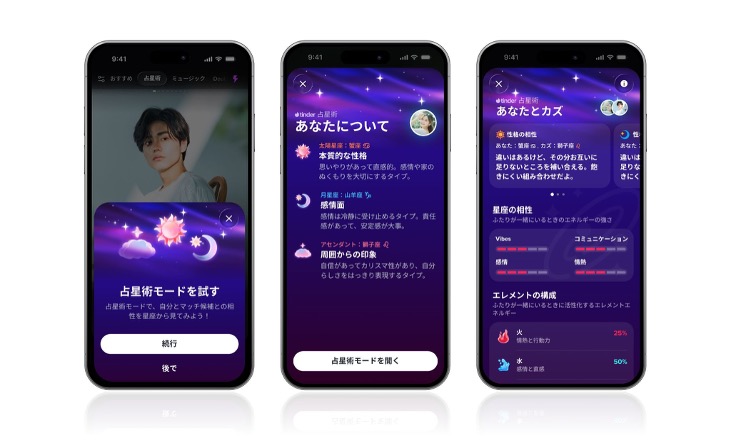
The polished presentation leaves an obvious question: is Tinder also choosing people for you on astrological grounds? Its Japanese explanation explicitly says the mode does not prioritise people with better astrological compatibility. It also says the birth details used for the calculation are not shown to other members. The feature adds information to the decision in front of you; it does not promise to put your most compatible sign first.
That distinction can get lost in the design. A person describing themselves as slow to open up is offering a self-description. An app placing two people's traits side by side, complete with coloured scales, looks more like an assessment. The same presentation that makes the information easy to read can also make it feel more conclusive than a casual conversation about star signs.
A Like is where the evidence stops
Tinder has reported an encouraging result for the feature. Its global announcement says early testing found a nearly 20% increase in Likes sent by women on Astrology profiles. The footnote identifies a February 2, 2026 comparison of Swipe Right rates across ten markets, including Canada and Japan. That is evidence of a difference in how profiles were received in that test. The announcement does not report how many of those Likes became conversations, dates or relationships.
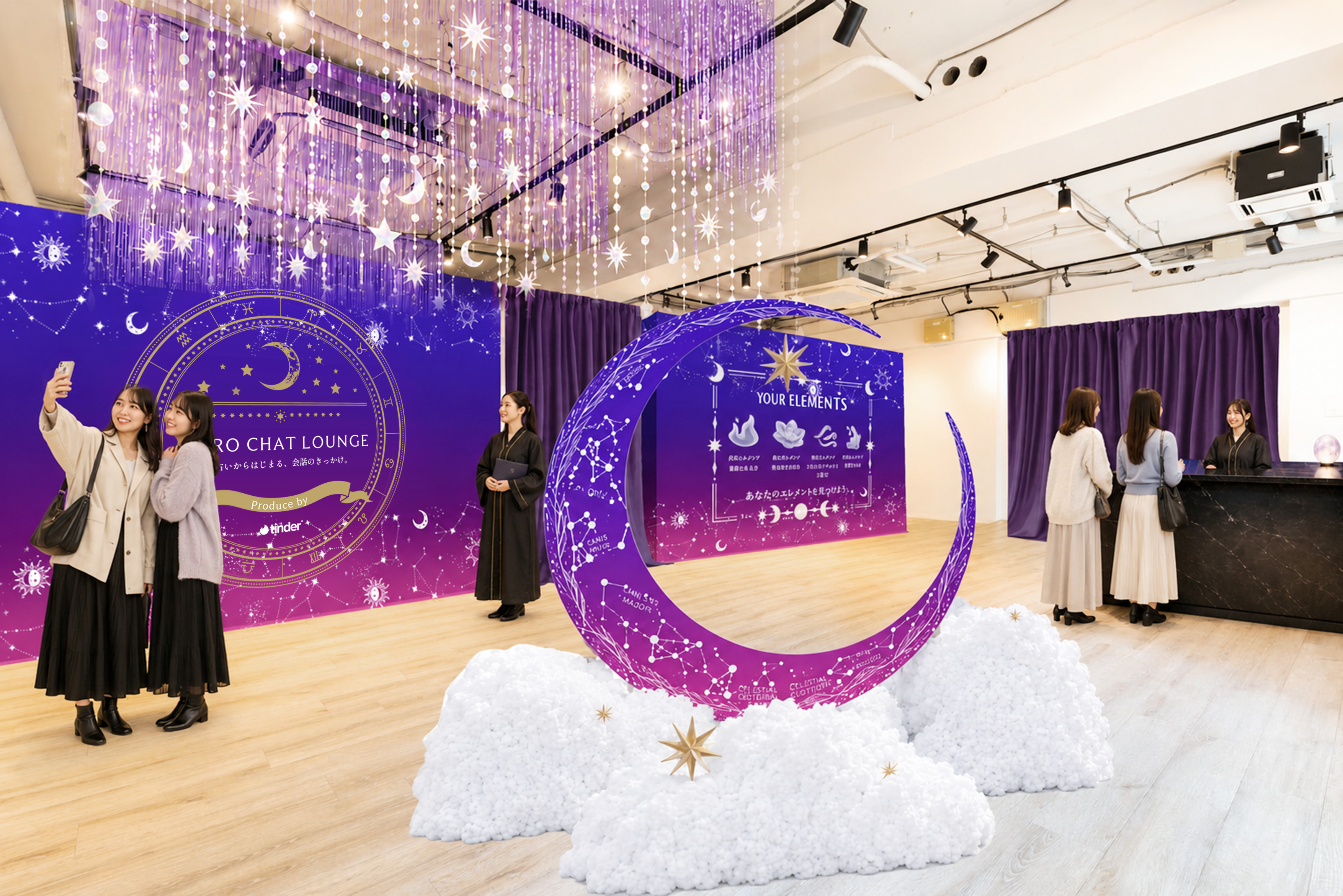
The company also took the idea beyond a profile card in its promotional plans. A May announcement scheduled ASTRO CHAT LOUNGE in Shibuya for June 18–22, with professional and student readers offering consultations and advice on starting conversations. Access to the readings required downloading Tinder and setting up Astrology Mode. Even at the consultation table, the planned service came back to helping someone find an opening line.
That is where Tinder's use of astrology makes the most sense. A reading can give a profile another point of interest and offer an excuse to ask a question. Once a conversation starts, there are better things to go on: whether the other person gets your joke, listens to the answer, or remembers something you said. A compatibility card cannot do that part of getting acquainted for you.
Recommended
 FateKitSponsoredBest for astrology and Chinese-metaphysics readers who want to compare several chart systems for the same moment, inspect the sky data behind them, and prepare structured context for an external AI without uploading a profile by default.
 Cantian AIFor people who want AI Bazi readings and also want to cast a hexagram, check feng shui, or choose a name in the same app.
Sources
- TinderTinder's test disclosure
- Tinder CanadaTinder Canada
- Tinder GermanyTinder Germany
- Tinder JapanThe Shibuya event announcement
Similar stories
ChatGPT Reads Birth Charts Fluently. In One Test, 49 of 50 Charts Were Wrong
A journaling-app maker tested free ChatGPT's model on 50 invented births: every Sun sign was right, but the Rising sign was wrong in 33 of 40, and web search didn't fix it all. The same week, a Korean AI saju service filed patents on checking AI readings against a computed chart.
AI AstrologyBirth Chart
Too Much Water in Your Chart? This Hotel Suggests a Hike
At Perdue on Türkiye’s coast, a resident astrologer reads guests’ charts and builds an itinerary from the hotel’s own activities. The reading costs €80 for 50 minutes.
Birth ChartAstrology Marketplaces
What if your birth chart was wrong before the AI started talking?
AI astrology can make an answer sound smooth, but birth time, birthplace, timezone, zodiac setting, and house system choices still decide what chart the answer is built on.
Birth ChartAI Astrology