One questionnaire across twelve systems
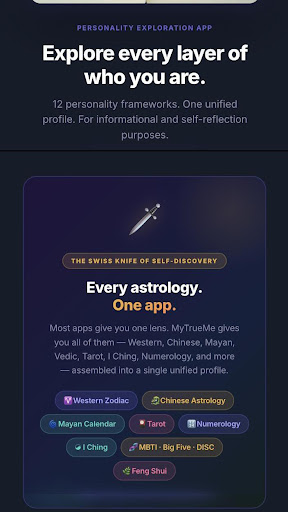
MyTrueMe puts twelve personality frameworks behind one questionnaire. The individual results cover Western astrology with Sun, Moon and Rising signs; Chinese Zodiac; the Mayan Haab' and Tzolk'in calendars; Vedic astrology; a natal chart with planets and houses; Pythagorean and Chaldean numerology; birth Tarot archetypes; I Ching; personal Feng Shui; MBTI; Big Five; and DISC.
Each profile has its own descriptions, strengths, weaknesses, relationship themes and career inclinations. The optional Unified Deep Profile then looks for repeated patterns across the separate systems instead of asking the user to compare twelve reports manually. Relationship compatibility, career preferences and a personal Feng Shui map extend the same profile into more specific questions.
Scientific models and symbolic traditions are labeled separately
The public methodology does not present every framework as equally scientific. It separates empirically supported models such as Big Five and Holland Codes, instruments with partial or mixed support such as MBTI and DISC, and cultural-symbolic traditions such as astrology, numerology, Tarot, I Ching and Feng Shui.
Big Five is used as a reference vocabulary for comparing recurring descriptions, while symbolic outputs are presented as tendencies and narrative themes rather than predictions or diagnoses. The methodology also explains the limits of mapping different systems into shared adjectives and says that the mapping is for readability, not evidence that the systems measure the same thing.
Free individual profiles, with an optional combined upgrade
The twelve individual profiles are presented as free. The Unified Deep Profile is an optional paid upgrade. Google Play says the Android experience can be started without an account; on the web, the questionnaire route currently leads to the login screen.
The privacy policy says the service stores account details, questionnaire responses, date of birth, gender and general location in MongoDB Atlas. It says a full name is not stored, payment confirmation comes from PayPal, and personal data is not sold or shared for marketing. MyTrueMe is positioned for information, entertainment and self-reflection rather than psychological, medical or therapeutic advice.