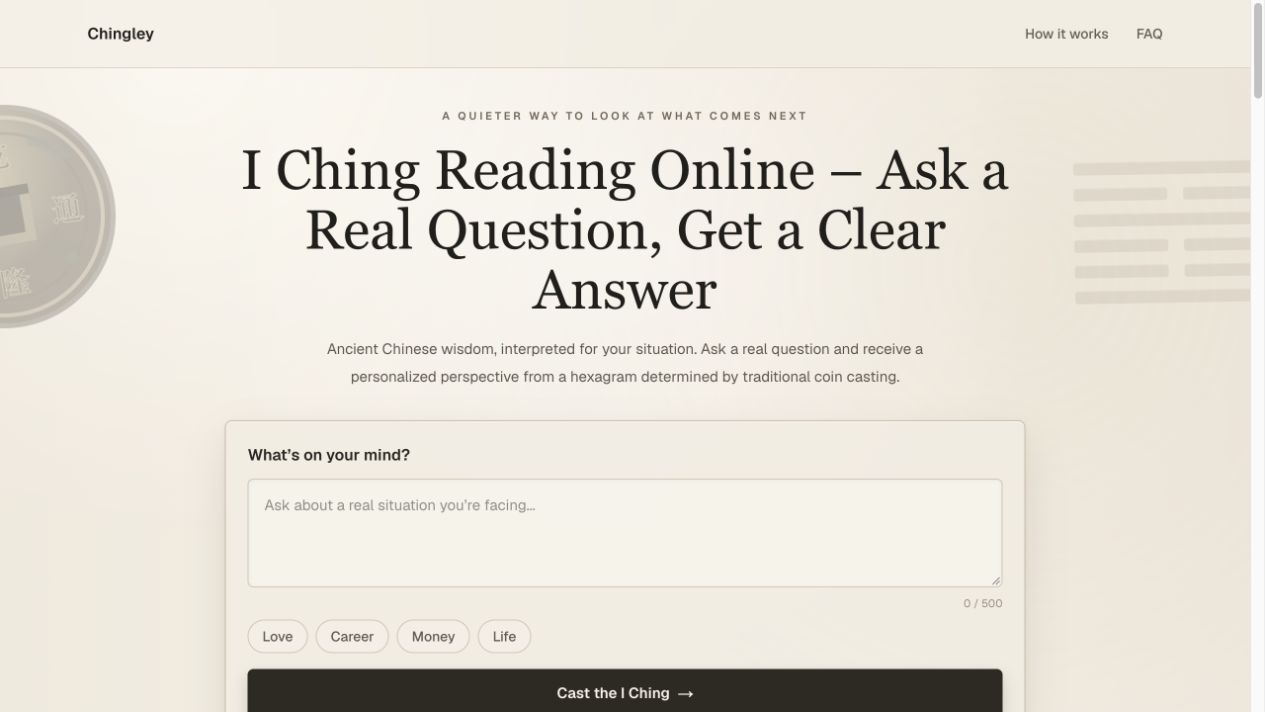
Chingley, formerly I Ching Advisor, starts with a question and six virtual three-coin tosses. You write a situation in up to 500 characters, then cast each line yourself from the bottom of the hexagram upward. Each coin is described as having an independent, equal chance of either side. The six results determine the primary hexagram, any changing lines and the relating hexagram before AI receives the question.
After the cast, the result names both hexagrams and marks the changing positions. The free Quick Reading connects the fixed result to the question in plain English. AI interprets the cast; it does not pick a hexagram, reroll a coin or change a line. The privacy page says the server reconstructs the cast from the six line values before asking the AI provider, DeepSeek, to interpret it.
You can cast and read the Quick Reading without an account. An optional $1.99 Deep Reading expands the same cast with reasons for caution or action, risks, conditions and next steps. It is a one-time purchase for that reading, handled by Paddle, rather than a subscription. The service does not offer a general reading history, though a question, cast and reading record remain temporarily available for about 30 days.
The public library covers all 64 hexagrams in King Wen order. A separate changing-lines guide explains why 6 and 9 move, how they form a relating hexagram, and how to read one, several or no changing lines. It treats the relating hexagram as another view of the situation, not a guaranteed future.