LogoAstroDir
GetBirthChart icon

GetBirthChart

Free English Western-astrology site for natal charts, synastry, yearly transits, transparent Swiss Ephemeris calculations, and optional AI questions grounded in the calculated chart.

4.2
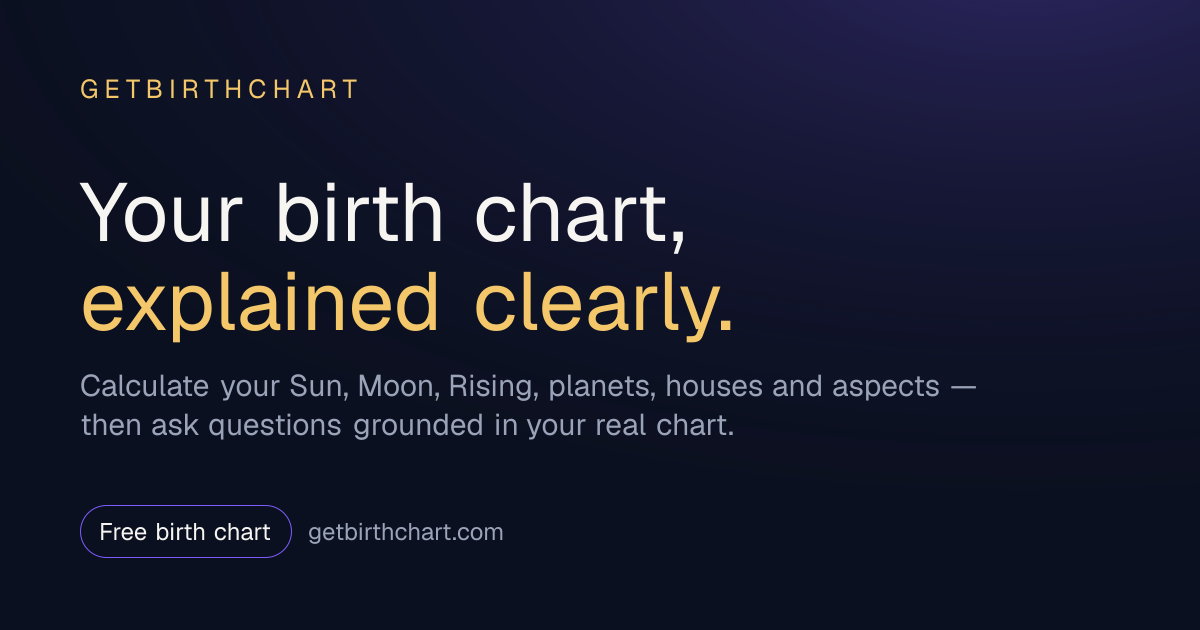
GetBirthChart official artwork introducing its free birth chart and chart-grounded questions
Preview

Editor note

Last checked August 30, 2026
  • Unknown birth time is not replaced with midnight or noon; Rising, houses, and angles are omitted, and a Moon sign can be marked time-dependent.
  • Each chart records its calculation-engine, ephemeris, and timezone-data versions, making a result easier to trace.
  • Placidus is the default, with Whole Sign and Equal available; aspect orbs and high-latitude limits are published.
  • AI receives selected structured chart evidence after calculation, and the free layer includes three chart-grounded questions.

Best for

Best for Western-astrology readers who care about unknown-time handling, calculation provenance, and published methodology, or who want to try a free natal chart or two-person synastry preview before buying a one-time report.

Overview

About GetBirthChart

Calculate the chart before interpreting it

GetBirthChart's free layer includes a natal wheel, planetary placements, houses, aspects, balance summaries, Today's Sky transits, a year-ahead preview, and three AI questions. The form accepts a birth date, time, and place, then sends the normalized time and coordinates to a dedicated calculation engine. Tropical zodiac with Placidus houses is the default, while Whole Sign and Equal houses can be selected in the advanced settings.

The result keeps calculation and interpretation separate. Planetary positions come from Swiss Ephemeris through the open-source gbc-astro Python engine. Local time is resolved through the IANA timezone database, and every chart records the engine, ephemeris, and timezone-data versions used to produce it.

Unknown birth time stays unknown

If the exact time is unavailable, GetBirthChart does not silently substitute midnight or noon. Rising sign, houses, and chart angles are omitted. Most planetary signs remain available, while the Moon is marked as time-dependent when it crosses a sign during that local date. The public methodology also documents aspect orbs, high-latitude Placidus limits, daylight-saving boundaries, and regression cases.

Synastry, yearly timing, and chart-grounded questions

The compatibility tool compares two full charts through cross-chart aspects, house overlays, and a composite rather than relying on Sun signs alone. The yearly view combines annual transits with a Solar Return. Both begin with a free preview.

AI interpretation sits after the calculation. The model receives selected structured chart evidence rather than inventing placements, and the published architecture excludes the chart UUID, email, coordinates, place label, and date of birth from the reading payload. A full natal reading is $9.99 and a couple reading is $14.99, both one-time purchases; additional question packs are also sold once rather than as subscriptions. Charts are private by default, an account is optional for the basic calculators, and the privacy policy says birth data is not sold.

FAQ

What is included for free?

The free natal path includes the full chart, wheel, placements, houses, aspects, balance summaries, Today's Sky transits, a year-ahead preview, a reading preview, and three chart-grounded AI questions. Compatibility also has a free preview with three relationship questions.

What happens if I do not know my birth time?

Rising sign, houses, and chart angles are omitted rather than guessed. Planetary signs that remain stable can still be shown, while a Moon sign that changes during the local date is marked as time-dependent.

How are charts calculated?

The open-source gbc-astro engine uses Swiss Ephemeris through pyswisseph. Local birth time is converted through the IANA timezone database, and the chart records the calculation and data versions used.

Does the AI calculate planetary positions?

No. The engine calculates the chart first. AI receives selected structured evidence from that result and writes reflective interpretation without recomputing or inventing chart facts.

Collections

Back to directory

Related resources

AddedRating4.1
AddedRating4.0